
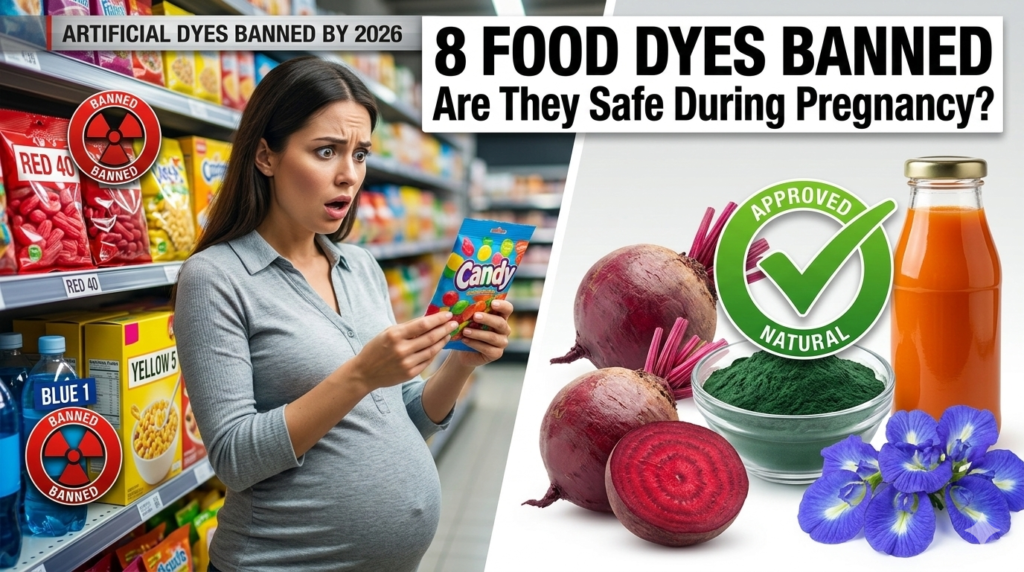
FDA Update 2026: Eight petroleum-based food dyes are being banned by end of 2026. If you are currently pregnant, this guide tells you exactly which dyes are in your food right now, what health risks they carry, and what is actually safe during pregnancy.
If you have been wondering whether food dyes banned during pregnancy 2026 is something you need to worry about, the answer is yes – and you are not alone. Millions of pregnant women across the United States are eating foods that still contain petroleum-based artificial dyes every single day, often without knowing it. The FDA has now made its position clear: these eight synthetic dyes do not belong in the American food supply, and they are being phased out by the end of 2026.
This article gives you the complete list of all eight banned food dyes, explains exactly what health risks each one carries, tells you which everyday foods contain them right now, and most importantly – tells you what is safe to eat during your pregnancy while this transition happens.
Also Read : FDA Approves New Natural Food Dyes in 2026 – Are They Safe During Pregnancy?
Why Are Food Dyes Being Banned During Pregnancy and Beyond in 2026?
The push to remove artificial food dyes from the US food supply has been building for years, but 2025 was the turning point. On April 22, 2025, FDA Commissioner Dr. Marty Makary announced the artificial food dye ban alongside Health and Human Services Secretary Robert F. Kennedy Jr., saying the decision comes in response to growing concerns over the health effects of petroleum-based food dyes, especially in children.
The concern is straightforward. These dyes are made from petroleum – the same base material used to make gasoline and plastic. They offer zero nutritional benefit. And a growing body of research links them to behavioral problems, hyperactivity, and potential carcinogenic effects. HHS Secretary Kennedy stated that these compounds offer no nutritional benefit and pose real, measurable dangers to children’s health and development.
For pregnant women, the stakes are even higher. Your baby’s developing brain, nervous system, and organs are more sensitive to chemical exposure than an adult’s. What you eat during pregnancy crosses the placenta and reaches your baby directly. This is why understanding exactly which food dyes are being banned – and where they are hiding in your food – matters so much right now.
The Complete List of 8 Food Dyes Banned by End of 2026
Here is every dye being phased out, what it is used in, and what the research says about its safety during pregnancy:
1. Red Dye No. 40 (Allura Red AC) – Most Common
Red No. 40 is the most widely used food dye in the United States. It appears in hundreds of products – from fruit punch and strawberry yogurt to maraschino cherries and children’s medications. Research found that Red No. 40 may cause hypersensitivity reactions and has been linked to behavioral changes in children. For pregnant women, the concern is that any substance linked to nervous system effects in children is worth avoiding during fetal development when the brain is being formed.
Found in: Red Kool-Aid, Skittles, M&Ms, strawberry ice cream, fruit punch, red velvet cake mix, some cereals, children’s vitamins
2. Yellow Dye No. 5 (Tartrazine)
Tartrazine has been shown in research to cause allergic reactions, particularly in people who are sensitive to aspirin, and hyperactivity in children. During pregnancy, allergic responses can trigger inflammatory reactions that are best avoided. Yellow No. 5 is also one of the few food dyes that must be specifically listed on labels due to known allergy concerns – a telling sign of its risk profile.
Found in: Mountain Dew, yellow mustard, mac and cheese powder, lemon-lime sodas, some pickles, flavored chips
3. Yellow Dye No. 6 (Sunset Yellow FCF)
Animal tests referenced in research linked Yellow No. 6 to adrenal and kidney tumors, though the FDA disputes these findings. It is also suspected to exacerbate hyperactivity in children. Regardless of the ongoing debate, the FDA’s decision to phase it out reflects the precautionary principle – when a substance has documented concerns and no nutritional benefit, removing it is the right call.
Found in: Orange soda, some cereals, baked goods, candy, macaroni and cheese
4. Blue Dye No. 1 (Brilliant Blue FCF)
Research found that Blue No. 1 may interfere with nerve cell development. This is particularly concerning during pregnancy because your baby’s nervous system is actively developing throughout all three trimesters. Any substance with a documented link to nerve cell interference is worth avoiding when you are growing a baby.
Found in: Blue Gatorade, Powerade, blue candy, some ice cream, blue frosting, blue corn chips
5. Blue Dye No. 2 (Indigo Carmine)
Blue Dye No. 2 has shown evidence of brain tumor development in rats. While the translation from animal studies to human risk is not always direct, the concern is serious enough that the FDA has included it in the phase-out list. During pregnancy, choosing to avoid foods with Blue No. 2 is a reasonable precautionary step.
Found in: Some blue-colored candies, certain medications, colored cereals, blue drink mixes
6. Green Dye No. 3 (Fast Green FCF)
Green No. 3 has been associated with bladder tumors in animal research. It is one of the less commonly used dyes, but it still appears in some green-colored candies, beverages, and processed foods. Its inclusion in the FDA’s phase-out list reflects the same precautionary approach applied to all eight banned dyes.
Found in: Some green candies, mint-flavored products, certain canned vegetables, some colored beverages
7. Citrus Red No. 2
Citrus Red No. 2, which is primarily used on the skin of oranges, has been shown to cause bladder and internal tumors in animal studies. This is one of the lesser-known dyes because it does not appear inside food – it is sprayed on the outside of orange peels to make them look more uniformly orange. Washing your oranges thoroughly before eating them is especially important during pregnancy.
Found in: Skin of some commercially grown oranges in the US (not in the fruit itself – only on the peel)
8. Orange B
Orange B was once used in sausage casings and has mostly fallen out of use. Studies cited by researchers linked it to carcinogenic outcomes in lab animals. While this dye is rarely encountered today, its formal authorization is being revoked as part of the complete phase-out of all petroleum-based synthetic dyes from the US food supply.
Found in: Rarely used today – historically in some sausage casings
Complete List – All 8 Food Dyes Banned by 2026 at a Glance
| # | Dye Name | Common Foods | Main Concern | Status |
|---|---|---|---|---|
| 1 | Red No. 40 | Skittles, Kool-Aid, yogurt | Hyperactivity, hypersensitivity | Phase out 2026 |
| 2 | Yellow No. 5 | Mountain Dew, mustard | Allergic reactions, hyperactivity | Phase out 2026 |
| 3 | Yellow No. 6 | Orange soda, chips | Adrenal tumors (animal studies) | Phase out 2026 |
| 4 | Blue No. 1 | Gatorade, blue candy | Nerve cell interference | Phase out 2026 |
| 5 | Blue No. 2 | Colored cereals, candy | Brain tumors (animal studies) | Phase out 2026 |
| 6 | Green No. 3 | Green candy, mint products | Bladder tumors (animal studies) | Phase out 2026 |
| 7 | Citrus Red No. 2 | Orange peel (skin only) | Bladder/internal tumors (animals) | Revoked – Coming months |
| 8 | Orange B | Old sausage casings (rare) | Carcinogenic (animal studies) | Revoked – Coming months |
Are These Food Dyes Still in Your Food Right Now During Pregnancy?
Yes – and this is the part that surprises most people. The FDA is working with food manufacturers, retailers, and trade associations to eliminate six remaining certified color additives from the food supply by the end of 2027. The phase-out is voluntary, not an immediate mandatory ban. That means Red 40, Yellow 5, Yellow 6, and the others are still legally present in thousands of products on grocery store shelves today.
Some major brands have already begun reformulating. But many have not yet made the switch. The safest approach during pregnancy right now is to read ingredient labels carefully. If you see any of the eight dye names listed – Red 40, Yellow 5, Yellow 6, Blue 1, Blue 2, or Green 3 – that product still contains petroleum-based synthetic dye.
Tip: Look for FD&C before the color name on ingredient labels. FD&C Red No. 40, FD&C Yellow No. 5 – the “FD&C” prefix tells you it is a certified synthetic dye. If you see “colored with beet juice” or “colored with spirulina” – that is a natural dye and is safe.
Safe Natural Alternatives Approved by FDA in 2026
The good news is that the FDA has been actively approving natural color alternatives to replace the banned synthetic dyes. The FDA recently approved natural color additives for food, including beetroot red and expanded use of spirulina extract, further expanding the palette of alternatives available to manufacturers.
| Natural Dye | Source | Replaces | Safe in Pregnancy? |
|---|---|---|---|
| Beetroot Red | Fermented beets | Red No. 40 | ✓ Yes |
| Spirulina Extract | Blue-green algae | Blue No. 1 and 2 | ✓ Yes |
| Butterfly Pea Flower | Natural flower extract | Blue No. 1 | ✓ Yes |
| Galdieria Extract Blue | Red algae | Blue No. 2 | ✓ Yes |
| Beet juice, Carrot juice | Vegetables | Red, Orange dyes | ✓ Yes |
How to Read Labels to Avoid Food Dyes During Pregnancy
Now that you know which food dyes are being banned during pregnancy and why, here is a practical label-reading guide to protect yourself right now – before the phase-out is complete.
Step 1 – Flip the package over and find “Ingredients.” Do not rely on front-of-pack claims like “natural” or “no artificial colors” – these labels are changing and can be confusing.
Step 2 – Scan for FD&C. Any ingredient starting with “FD&C” is a certified synthetic petroleum-based dye. Put the product back.
Step 3 – Look for specific names. Red 40, Yellow 5, Yellow 6, Blue 1, Blue 2, Green 3 – these may appear without the FD&C prefix on some older labels.
Step 4 – Choose products that say “colored with [plant].” Colored with beet juice, turmeric, carrot juice, spirulina, or annatto – these are all natural and safe alternatives.
Step 5 – When in doubt, choose the plain version. The colorful version of any snack food is almost always the one with synthetic dyes. Plain chips, unflavored crackers, white cereals – these typically have no color additives at all.
Frequently Asked Questions
1. Are the 8 food dyes being banned dangerous during pregnancy?
Based on available research, these eight food dyes being banned during pregnancy 2026 carry documented concerns – including links to behavioral changes, allergic responses, and tumor development in animal studies. None of them offer any nutritional benefit. The FDA’s decision to phase them out reflects the precautionary principle: when a substance has health concerns and no value to the food, removing it is the right choice. During pregnancy, when your baby is directly exposed to what you eat, limiting these dyes is a reasonable precaution.
2. I already ate food with Red 40 during pregnancy – should I be worried?
No. Occasional exposure to these dyes is not the same as harm. The research concerns are primarily about chronic, high-level consumption – not a single serving of something colored with Red 40. If you have been eating normally and are now learning about this, there is no reason to panic. Going forward, reading labels more carefully is the practical step. Your prenatal care team is the right resource if you have specific concerns about your individual pregnancy.
3. When exactly will food dyes be banned and completely gone from store shelves?
The FDA’s target for the voluntary industry phase-out of the six most common synthetic dyes is end of 2026, with some updates extending to 2027. Citrus Red No. 2 and Orange B are being revoked sooner. However, because this is a voluntary transition – not a mandatory federal ban – the actual timeline will vary by brand and product. Some companies have already switched. Others may take longer. Expect to still find products with synthetic dyes in stores through 2026 and into 2027.
4. Does food dye cross the placenta and reach the baby?
Most substances that enter the mother’s bloodstream through digestion can cross the placental barrier to some extent. Synthetic food dyes are absorbed through the digestive tract and enter the bloodstream. Whether they cross the placenta in meaningful amounts has not been extensively studied in humans, but the precautionary approach – particularly given the FDA’s own decision to phase these dyes out – supports minimizing exposure during pregnancy.
5. Are natural food dyes like beetroot red and spirulina safe during pregnancy?
Yes. The newly approved natural food dyes – including beetroot red, spirulina extract, butterfly pea flower, and galdieria extract blue – are all derived from plant or algae sources with no known harmful effects during pregnancy. At the levels present in food products, they are considered safe. They represent a genuine improvement over the petroleum-based dyes they are replacing and are a much better choice during pregnancy.
6. Does the food dye ban apply to prenatal vitamins and medications?
Yes – the FDA’s phase-out extends to medications and drug products as well as food. Some prenatal vitamins and liquid medications use FD&C dyes as colorings. If you prefer to avoid synthetic dyes in your prenatal supplements, look for products specifically labeled as dye-free. Many prenatal vitamin brands already use naturally derived colorings or clear coatings, and your pharmacist can help you identify dye-free options.
7. Which popular foods still have the banned food dyes right now in 2026?
As of early 2026, many familiar products still contain synthetic dyes that are being phased out. These include brightly colored cereals like Froot Loops and Lucky Charms, Skittles, M&Ms, Gatorade in colored varieties, Mountain Dew, Kool-Aid, colored fruit snacks, and some flavored chips and crackers. The transition is ongoing – check ingredient labels on each product individually since some brands are reformulating product by product rather than all at once.
The Bottom Line on Food Dyes Banned During Pregnancy 2026
The FDA’s decision to phase out all eight petroleum-based synthetic food dyes by end of 2026 is one of the most significant changes to the US food supply in decades. For pregnant women, it is a meaningful development – these dyes are being removed precisely because the health risks, particularly for developing children, outweigh any benefit.
The good news is that you do not need to wait for the phase-out to be complete. You can start reading labels today, identify which products in your regular diet contain these dyes, and swap them for natural-color or dye-free alternatives. The transition happening at the FDA level is simply catching up to what many health-conscious pregnant women have already been doing.
Your baby’s development depends on what crosses the placenta – and choosing foods free of petroleum-based synthetic dyes is one more way to give your pregnancy the best possible foundation.
Stay updated on the latest pregnancy food safety and health news at usgreport.com – written in plain language for real patients, not just medical professionals.
Sources: US Food and Drug Administration (FDA.gov) | US Department of Health and Human Services (HHS.gov) | Center for Science in the Public Interest (CSPI) | Newsweek Health | Mayer Brown Legal Analysis | Kerry Regulatory Affairs

