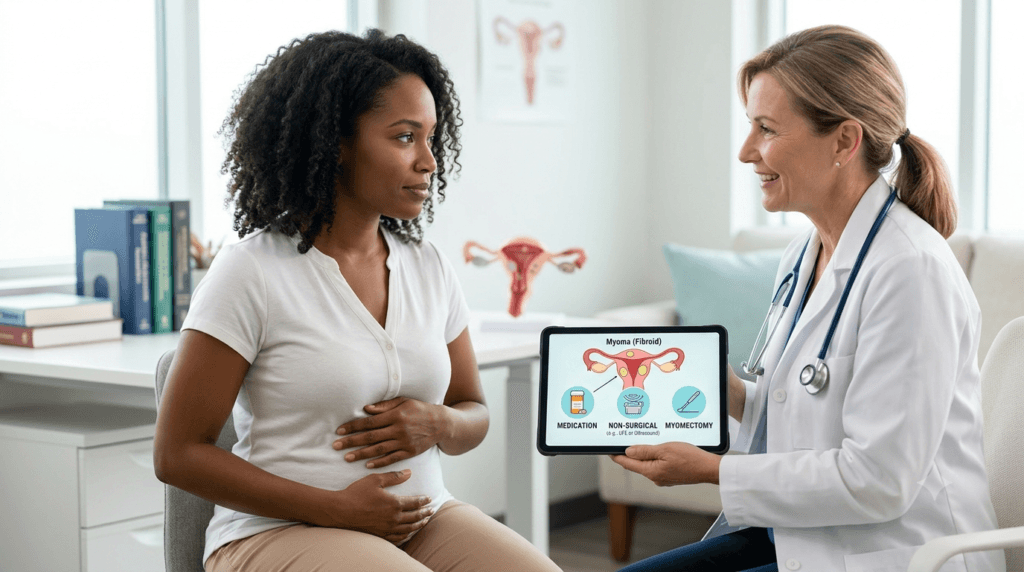
Uterine fibroids are incredibly common, affecting up to 70% to 80% of women by the time they reach age 50. Despite how widespread they are, receiving a diagnosis can feel overwhelming. Many women immediately worry that they will need a hysterectomy (major surgery to remove the uterus).
Fortunately, the medical landscape has shifted completely. Modern treatments prioritize uterine preservation, offering a wide range of choices from daily oral medications to non-invasive outpatient procedures that require zero incisions.
This comprehensive guide breaks down every major uterine fibroid treatment option available in the United States today to help you make an informed decision alongside your healthcare provider.
Understanding Uterine Fibroids and Symptoms
Uterine fibroids (also called leiomyomas) are benign (non-cancerous) growths of muscle tissue that develop inside or on the walls of the uterus. While some women never experience symptoms, others face severe daily disruptions.
The most common symptoms include:
- Abnormal or Heavy Menstrual Bleeding (AUB-L): Prolonged periods, soaking through pads rapidly, or passing large blood clots.
- Pelvic Pain and Pressure: A chronic feeling of fullness, aching, or sharpness in the lower abdomen.
- Bulk Symptoms: An enlarged abdomen, frequent urination (caused by the fibroid pressing against the bladder), or constipation.
- Reproductive Issues: Difficulty getting pregnant, recurrent miscarriages, or complications during delivery.
If you are asymptomatic, active clinical surveillance (watchful waiting) is often all that is recommended. However, if your symptoms interfere with your quality of life, it is time to explore treatment options.
1. Medical and Hormonal Therapies (Non-Surgical)
Medications are often the first line of defense, especially for women looking to manage heavy bleeding or bridge the gap before a scheduled procedure. While these treatments do not cure fibroids permanently, they provide significant relief.
Also Read : Vitamin D Deficiency Symptoms and Best Treatment Options
Oral GnRH Antagonists (With Add-Back Therapy)
Oral non-peptide Gonadotropin-Releasing Hormone (GnRH) antagonists are a leading treatment class. Approved formulations like Relugolix combination therapy and Elagolix with add-back therapy work by reversibly blocking the body’s natural production of estrogen and progesterone, which starves the fibroids of the hormones they need to grow.
- How it works: To prevent the intense menopausal side effects (like bone density loss or hot flashes) associated with low estrogen, these pills come packaged with a tiny dose of “add-back” hormones.
- Usage: The American College of Obstetricians and Gynecologists (ACOG) guidelines approve oral GnRH antagonists for up to 2 years of continuous use.
GnRH Agonists
Injectable medications like Leuprolide acetate (Lupron) suppress ovulation and induce a temporary, reversible “pseudomenopause”.
- Pros: Highly effective at temporarily shrinking fibroids by 30% to 50% and stopping heavy bleeding.
- Cons: Because of the risk of bone mineral density loss, they are strictly limited to short-term use (typically under 6 months), often directly preceding a myomectomy surgery to minimize intraoperative bleeding.
Hormonal IUDs and Birth Control
A 52-mg levonorgestrel-releasing intrauterine device (like Mirena) or low-dose combination birth control pills can stabilize the uterine lining. While they do not reduce the physical size of the fibroid, they are highly effective at regulating heavy cycles and reducing cramping.
Tranexamic Acid
For women avoiding daily hormone regimens, Tranexamic acid is a non-hormonal prescription pill taken exclusively during heavy bleeding days. It helps blood clot more efficiently in the uterine wall, reducing menstrual fluid volume by up to 40%.
2. Minimally Invasive and Non-Invasive Procedures
If medications do not offer enough relief, but you wish to avoid a traditional operating room, advanced non-surgical and outpatient options offer faster recovery times.
Uterine Fibroid Embolization (UFE) / Uterine Artery Embolization (UAE)
UFE is a highly successful, minimally invasive alternative to surgery performed by an interventional radiologist.
- The Procedure: A doctor inserts a tiny catheter through a microscopic nick in the wrist or groin. Guided by real-time imaging, they inject tiny gelatin or plastic particles into the specific blood vessels feeding the fibroids. This cuts off the blood supply, causing the fibroid tissue to shrink and die over several months.
- Recovery: Most patients return to normal activities within 7 to 10 days. Success rates for halting abnormal bleeding sit between 85% and 90%.
MRI-Guided Focused Ultrasound (MRgFUS)
Representing the cutting edge of completely incision-free medical technology, MRgFUS is a specialized outpatient procedure.
- The Procedure: The patient rests inside an MRI scanner, which provides real-time three-dimensional thermal maps of the uterus. The physician directs high-intensity ultrasound waves directly at the fibroid. The focused energy heats and destroys the targeted tissue on a cellular level while leaving the surrounding healthy muscle completely untouched.
- Recovery: Zero cuts, zero needles, and zero hospital stays. Most women are back to their normal routines within 24 to 48 hours.
Radiofrequency Ablation (RFA)
RFA treatments (such as the Accessa or Sonata systems) use targeted radiofrequency energy to induce coagulative necrosis (tissue death) within the fibroid. RFA can be performed via a laparoscopic approach (through small keyhole abdominal cuts) or a transcervical approach (navigated directly through the cervix with no incisions). Fibroids lose mass over the following weeks, drastically relieving bulk pressure.
Also Read : 10 Early Signs of Diabetes You Should Never Ignore
3. Surgical Options (Uterine-Preserving vs. Definitive)
When fibroids are exceptionally large, numerous, or embedded deeply into the uterine tissue, surgical intervention remains the most reliable path to permanent symptom elimination.
Myomectomy (Uterine-Preserving Surgery)
A myomectomy is a targeted surgery designed to remove the fibroids while leaving the healthy portion of your uterus intact. This is the golden standard recommendation for symptomatic women who plan to become pregnant in the future.
- Laparoscopic/Robotic Myomectomy: Performed through several small “keyhole” incisions in the lower abdomen using tiny cameras and robotic arms. This approach offers reduced scarring, minimal blood loss, and a recovery time of about 2 to 4 weeks.
- Hysteroscopic Myomectomy: Reserved for submucosal fibroids (those growing directly inside the uterine cavity). A thin scope is passed through the vagina and cervix to shave down the fibroid. It requires no external incisions and has a rapid 2- to 3-day recovery window.
- Abdominal Myomectomy (Open Surgery): Reserved for complex cases with massive or highly abundant fibroids. A larger incision is made across the bikini line, requiring a 4- to 6-week recovery period.
Hysterectomy (Definitive Cure)
A hysterectomy is the surgical removal of the entire uterus. It is the only 100% definitive, permanent cure for uterine fibroids, completely removing any risk of recurrence.
- Who it is for: This is typically recommended for women with severe symptoms who have completed childbearing and have not found success with less invasive methods.
- Approach: Whenever possible, modern gynecologists utilize minimally invasive techniques—such as vaginal or laparoscopic hysterectomies—to minimize pain and recovery time.
Key Comparison of Popular Treatment Options
| Treatment Category | Procedure / Medication | Core Benefit | Typical Recovery Time | Future Fertility Option? |
| Hormonal | Oral GnRH Antagonists | Stops heavy bleeding instantly | No downtime | Yes (after stopping) |
| Non-Invasive | MRgFUS | No incisions, targets specific fibroids | 1–2 Days | Limited data available |
| Minimally Invasive | Uterine Embolization (UFE) | Shrings multiple fibroids without surgery | 7–10 Days | Uncertain / Not ideal |
| Surgical | Laparoscopic Myomectomy | Physically removes fibroid tissue | 2–4 Weeks | Yes (Gold Standard) |
| Surgical | Hysterectomy | Permanent, absolute cure | 4–6 Weeks | No |
How to Choose the Right Treatment for You
Because fibroid care is highly individualized, there is no single “best” treatment. Your gynecologist will help you weigh your options based on five major factors:
- Your Reproductive Goals: If you wish to maintain fertility for a future pregnancy, options like standard myomectomy or certain medical therapies are strongly favored over UFE, RFA, or hysterectomies.
- Fibroid Characteristics: The size, location (subserosal, intramural, or submucosal), and total quantity of fibroids heavily dictate which treatment will succeed.
- Severity of Symptoms: If you suffer from life-altering anemia due to blood loss, fast-acting hormonal therapies or surgical extraction may take priority over slower options like UFE.
- Proximity to Menopause: Because fibroids are driven by natural hormones, they typically shrink on their own after menopause. If you are very close to menopause, short-term medical bridges or active surveillance might be your best option.
- Insurance & System Access: While major surgeries are universally covered, newer non-invasive treatments like MRgFUS may require case-by-case pre-authorization depending on your US insurance provider.
Takeaway: You do not have to live with the pain, heavy bleeding, and discomfort of uterine fibroids. Schedule an open conversation with your doctor to build a personalized treatment plan centered entirely around your health goals and lifestyle.