
Placental position plays a critical role in a healthy pregnancy and safe delivery. During routine ultrasound scans, many pregnant women are told they have either placenta previa or a low-lying placenta. Although these terms sound similar, they are not the same condition, and their implications for pregnancy and delivery can be very different.
Understanding the difference between placenta previa and a low-lying placenta can help reduce anxiety and allow expectant parents to make informed decisions with their healthcare provider. This article explains the key differences, causes, risks, diagnosis, and treatment options in simple, easy-to-understand language.
What Is the Placenta?
The placenta is a temporary organ that develops in the uterus during pregnancy. It supplies oxygen and nutrients to the baby and removes waste products through the umbilical cord. The placenta can attach anywhere inside the uterus, but its location becomes especially important in the later stages of pregnancy.
What Is Placenta Previa?
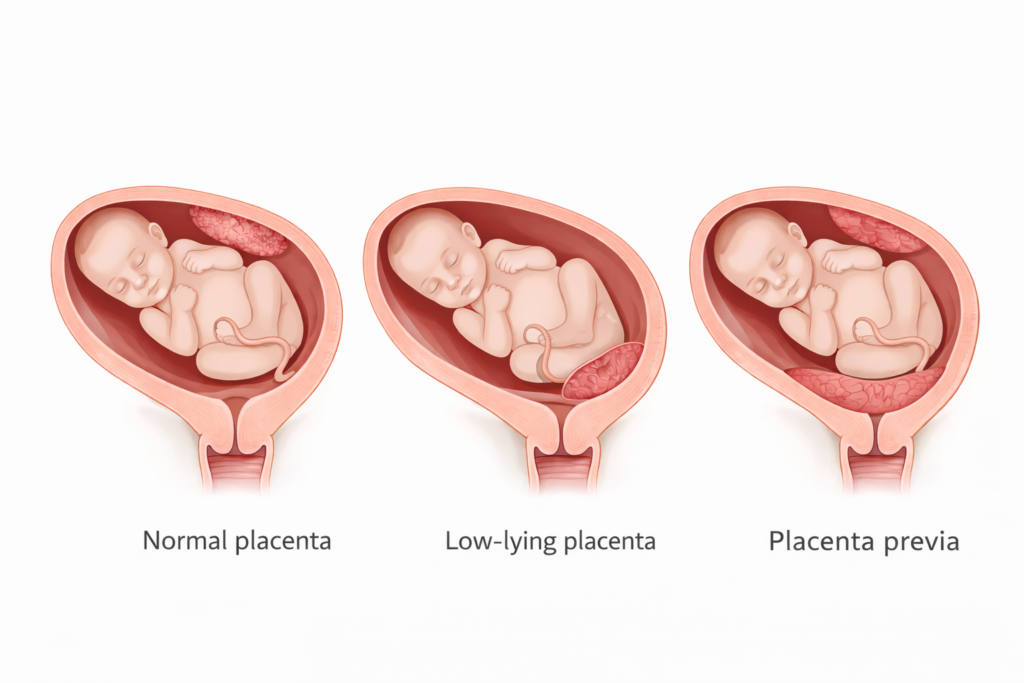
Placenta previa occurs when the placenta covers the cervix completely or partially. The cervix is the opening of the uterus through which the baby passes during vaginal delivery.
Also Read : Placenta Grade 3 During Pregnancy: Risks, Symptoms, and Delivery Options
Types of Placenta Previa
- Complete placenta previa – The placenta fully covers the cervical opening
- Partial placenta previa – The placenta partially covers the cervix
- Marginal placenta previa – The placenta reaches the edge of the cervix
Placenta previa is considered a serious condition, especially in the third trimester, because it can cause bleeding and complications during delivery.
What Is a Low-Lying Placenta?
A low-lying placenta means the placenta is located near the cervix but does not cover it. Typically, the placental edge is within 2 cm of the cervical opening but not blocking it.
Low-lying placenta is less serious than placenta previa and often resolves on its own as pregnancy progresses.
Placenta Previa vs Low-Lying Placenta: Key Differences
| Feature | Placenta Previa | Low-Lying Placenta |
|---|---|---|
| Placental position | Covers cervix | Near cervix, not covering |
| Severity | Higher risk | Usually mild |
| Chance of resolution | Less likely | Very likely |
| Bleeding risk | High | Low to moderate |
| Delivery method | Usually C-section | Often vaginal |
| Monitoring level | Very close | Routine with follow-up |
Why Do These Conditions Occur?
Several factors increase the risk of abnormal placental placement:
- Previous cesarean section
- Prior uterine surgery
- Multiple pregnancies (twins or more)
- Advanced maternal age
- Smoking
- Placenta implantation in early pregnancy
In many cases, the exact cause is unknown.
Can a Low-Lying Placenta Turn Into Placenta Previa?
No. A low-lying placenta does not “turn into” placenta previa. In fact, the opposite is more common.
As the uterus grows, the placenta often moves upward, away from the cervix. This is called placental migration and is very common.
Does Placenta Previa Ever Resolve?
- Placenta previa diagnosed early in pregnancy may resolve on its own
- If placenta previa persists into the third trimester, it usually does not resolve
Follow-up ultrasounds are essential to monitor placental movement.
Symptoms to Watch For
Placenta Previa Symptoms
- Painless vaginal bleeding in the second or third trimester
- Bleeding after intercourse
- Recurrent bleeding episodes
Low-Lying Placenta Symptoms
- Often no symptoms
- Mild spotting in some cases
Any vaginal bleeding during pregnancy should be reported to a healthcare provider immediately.
How Are These Conditions Diagnosed?
Both conditions are diagnosed through ultrasound, usually during the mid-pregnancy anatomy scan.
Additional tests may include:
- Transvaginal ultrasound (safe and more accurate)
- Doppler studies if needed
Ultrasound helps determine exact placental distance from the cervix, which guides treatment decisions.
Risks Associated With Placenta Previa
Placenta previa carries higher risks, especially later in pregnancy:
- Heavy vaginal bleeding
- Preterm birth
- Emergency cesarean delivery
- Placental separation
- Increased maternal blood loss
Because of these risks, placenta previa requires close medical supervision.
Risks Associated With a Low-Lying Placenta
Low-lying placenta usually has minimal risks, especially if it moves upward:
- Mild bleeding
- Possible delivery planning adjustments
- Temporary activity restrictions
Most women with a low-lying placenta deliver healthy babies without complications.
Treatment and Management: Placenta Previa
There is no way to reposition the placenta, so treatment focuses on reducing risk and planning delivery.
Common Management Strategies
- Pelvic rest (no intercourse or vaginal exams)
- Reduced physical activity
- Regular ultrasound monitoring
- Hospital observation in cases of bleeding
Delivery Planning
- Planned cesarean section is recommended
- Usually scheduled between 36–37 weeks, depending on bleeding risk
Vaginal delivery is not recommended with confirmed placenta previa.
Treatment and Management: Low-Lying Placenta
Management is generally conservative:
Monitoring
- Follow-up ultrasound at 28–32 weeks
- Additional scan near term if needed
Activity Advice
- Normal daily activities in most cases
- Avoid heavy lifting if advised
Delivery Planning
- Vaginal delivery is often safe
- Cesarean section only if placenta remains very close to the cervix
Can You Have a Normal Delivery With a Low-Lying Placenta?
Yes, in most cases.
If the placental edge moves more than 2 cm away from the cervix, vaginal delivery is usually safe. Many women with a low-lying placenta go on to have uncomplicated normal deliveries.
Emotional Impact and Reassurance
Being diagnosed with placenta previa or a low-lying placenta can cause anxiety. It is important to remember:
- Low-lying placenta often resolves naturally
- Placenta previa can be safely managed with proper care
- Modern prenatal monitoring significantly reduces risks
Clear communication with your healthcare provider can provide reassurance and confidence.
When Should You Seek Immediate Medical Care?
Contact your healthcare provider or go to the hospital immediately if you experience:
- Vaginal bleeding
- Severe abdominal pain
- Contractions before term
- Reduced fetal movements
These symptoms may require urgent evaluation.


Pingback: Low Amniotic Fluid Levels(AFI)- Causes, Normal Range, and Treatment - usgreport.com