
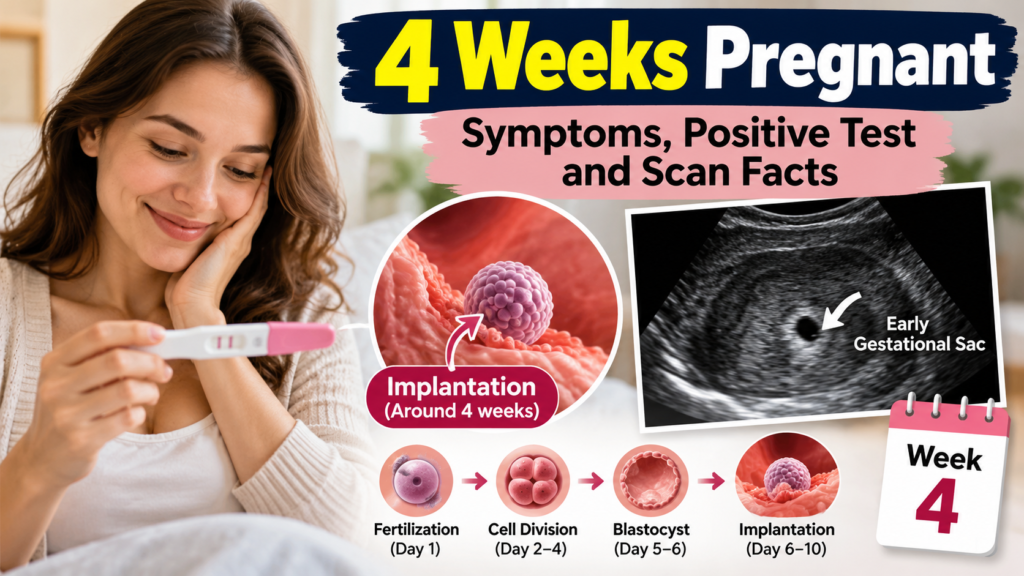
At 4 weeks pregnant, you may be seeing a positive pregnancy test for the first time, noticing mild cramps, or wondering why you do not feel pregnant yet. This is a very early stage of pregnancy, when implantation has usually occurred or is finishing, pregnancy hormone levels are beginning to rise, and the embryo is starting to develop. But what can you actually see on an ultrasound at 4 weeks? Is it normal to have a positive pregnancy test but no gestational sac on the scan? And which symptoms should you expect?
The answers depend partly on when you ovulated, when implantation occurred, and how your pregnancy is dated. A transvaginal ultrasound may show a tiny gestational sac around this time, but it is also common for a scan to be inconclusive at exactly 4 weeks. This guide explains 4-week pregnancy symptoms, pregnancy test results, early ultrasound findings, common report terms, and when to seek medical care.
Series navigation: Previous week: 3 Weeks Pregnant: Fertilization and Implantation Explained | Next week: 5 Weeks Pregnant
What Does 4 Weeks Pregnant Mean?
Pregnancy is counted from the first day of your last menstrual period (LMP), rather than from the date of conception. This means that at 4 weeks pregnant, you are typically around the time your next period is due. In a regular 28-day menstrual cycle, ovulation often occurs around day 14, fertilization may happen shortly afterward, and implantation usually occurs about 6–10 days after ovulation.
The embryo is therefore only around two weeks old in developmental terms, even though you are considered 4 weeks pregnant. These dates are estimates, not fixed rules. If you ovulated later than expected or have irregular periods, your pregnancy may be earlier than the calendar suggests.
At this stage, the developing embryo is microscopic or extremely small. The cells that will form the embryo and supporting pregnancy structures are differentiating, while the early foundations of the placenta are developing.
4 Weeks Pregnant Symptoms
Some people notice early pregnancy symptoms at 4 weeks, while others feel completely normal. Both experiences can occur in a healthy pregnancy. Symptoms are influenced by changing hormone levels, individual sensitivity, and the timing of implantation.
Common Symptoms at 4 Weeks
A missed period: If your menstrual cycle is regular, a missed period may be the first noticeable sign of pregnancy. However, stress, illness, and hormonal changes can also delay menstruation.
Breast tenderness: Your breasts may feel sore, fuller, or more sensitive than usual. These changes can resemble premenstrual symptoms.
Mild cramping: Light, period-like cramps can occur in early pregnancy. Severe, persistent, or one-sided pain should not be dismissed as normal pregnancy discomfort.
Fatigue: Rising progesterone levels and other early physiological changes may make you feel unusually tired.
Bloating: Hormonal changes can slow digestion, causing gas, bloating, or a feeling of fullness.
Nausea or food sensitivity: Some people begin experiencing nausea early, although pregnancy-related nausea more commonly develops later in the first trimester.
Frequent urination: You may notice that you need to urinate more often because of early hormonal and circulatory changes.
Light spotting: Some people experience light spotting in early pregnancy. Bleeding should not automatically be attributed to implantation, particularly after a positive pregnancy test.
Can You Have No Symptoms at 4 Weeks?
Yes. Having no symptoms at 4 weeks pregnant is common and does not, by itself, indicate a problem. Symptoms vary considerably between individuals and between pregnancies. Some people experience breast tenderness and fatigue immediately, while others do not notice changes until several weeks later.
Symptoms alone cannot confirm whether a pregnancy is progressing normally. A pregnancy test, clinical assessment, and appropriately timed ultrasound provide more useful information.
Can a Pregnancy Test Be Positive at 4 Weeks?
Yes. Many home pregnancy tests can detect pregnancy at 4 weeks because the body begins producing human chorionic gonadotropin (hCG) after implantation. This hormone enters the bloodstream and eventually appears in urine at detectable concentrations.
For many people with a regular cycle, a home pregnancy test is most useful on or after the day their period is expected. Follow the instructions on the package, and consider using first-morning urine if testing very early.
A faint positive line can still indicate pregnancy when the test is used correctly and read within the specified time window. Line darkness does not reliably measure pregnancy health or predict how hCG is changing. If the result is negative but your period does not arrive, repeat the test after a few days.
What Is a Beta-hCG Blood Test?
A quantitative beta-hCG blood test measures the amount of pregnancy hormone in your blood. It can sometimes detect pregnancy earlier than a urine test and may be recommended if you have bleeding, pelvic pain, uncertain dates, or an ultrasound that does not yet show a pregnancy.
One hCG result cannot establish the location or viability of a pregnancy. When clinically indicated, your provider may repeat the test, often approximately 48 hours later, and interpret the trend alongside your symptoms and ultrasound findings. hCG levels do not always double at exactly the same interval, and a single value should not be used to diagnose miscarriage or ectopic pregnancy.
What Does an Ultrasound Show at 4 Weeks Pregnant?
At 4 weeks pregnant, ultrasound findings can be subtle. A transvaginal ultrasound, which uses a probe placed in the vagina, provides a clearer view of early pregnancy than an abdominal scan. Even with transvaginal imaging, a gestational sac may not yet be visible at exactly 4 weeks.
The earliest possible finding is a tiny fluid-filled gestational sac within the uterus. Its visibility depends on the actual gestational age, equipment, imaging conditions, and other clinical factors. A yolk sac, embryo, and heartbeat are generally not reliably visible at this stage.
An abdominal ultrasound may show less detail because the early gestational sac is extremely small. If an early scan does not show a pregnancy, your clinician may recommend follow-up rather than drawing a conclusion from that scan alone.
Typical Ultrasound Findings at 4 Weeks
| Ultrasound structure | What may be seen |
|---|---|
| Uterus | Normal uterus, sometimes with early pregnancy-related changes |
| Endometrium | Thickened uterine lining |
| Gestational sac | May be visible on transvaginal ultrasound, but not always |
| Yolk sac | Usually not yet visible |
| Embryo or fetal pole | Usually too early to identify reliably |
| Cardiac activity | Not expected to be reliably visible |
| Corpus luteum | May be seen in an ovary after ovulation |
| Free pelvic fluid | May be absent; a small amount can sometimes be physiological |
These are general possibilities, not a diagnostic checklist. The absence of a structure at 4 weeks does not necessarily mean the pregnancy is abnormal.
What Does “No Gestational Sac Seen” Mean at 4 Weeks?
If your ultrasound report says “no intrauterine gestational sac seen,” it means the sonographer or radiologist did not identify a pregnancy sac inside the uterus at the time of the scan.
There are several possible explanations. You may be earlier in pregnancy than expected because ovulation or implantation occurred later. The pregnancy may be too small to detect on the scan. Alternatively, if your pregnancy test is positive, the pregnancy could be developing outside the uterus, known as an ectopic pregnancy, or the pregnancy may not be progressing.
A scan that shows no gestational sac cannot distinguish these possibilities by itself. If your pregnancy test is positive and the ultrasound does not identify the pregnancy, your clinician may describe the situation as a pregnancy of unknown location (PUL). This is a temporary clinical classification that requires follow-up until the pregnancy location or outcome is established.
Your clinician may recommend repeat quantitative beta-hCG testing and another transvaginal ultrasound, depending on your symptoms and initial findings. Do not assume that a missing sac at 4 weeks means a miscarriage, but do not ignore the finding if the pregnancy test is positive.
Common Phrases in a 4-Week Ultrasound Report
Early ultrasound reports can be confusing because they often describe findings without confirming a pregnancy.
| Report phrase | Meaning |
|---|---|
| Anteverted uterus | The uterus tilts forward, a common normal position |
| Thickened endometrium | The uterine lining is thicker, which can occur after ovulation and in early pregnancy |
| No gestational sac seen | No pregnancy sac was identified during this scan |
| Corpus luteum seen | A hormone-producing structure formed in the ovary after ovulation |
| No adnexal mass seen | No abnormal mass was identified around the uterus and ovaries |
| No significant free fluid | No substantial abnormal fluid was seen in the pelvis |
| Pregnancy of unknown location | A positive pregnancy test without a pregnancy located on ultrasound |
The significance of these phrases depends on your hCG results, symptoms, menstrual dates, and complete report. No single phrase should be interpreted in isolation.
When Will the Gestational Sac, Yolk Sac, and Heartbeat Appear?
Early pregnancy structures become visible gradually, and there is variation in the timing.
- Gestational sac: Often becomes visible on transvaginal ultrasound around 4.5–5 weeks, though timing varies.
- Yolk sac: Commonly becomes visible around 5–5.5 weeks.
- Embryo or fetal pole: Often becomes visible around 5.5–6 weeks or later.
- Cardiac activity: May become visible around 6 weeks, but sometimes later depending on dating and imaging.
These are approximate time ranges rather than deadlines. If a scan is performed too early, repeating it after an appropriate interval may provide much more information than an immediate repeat scan.
A clinician should use established ultrasound criteria before diagnosing pregnancy loss. If findings are uncertain, follow-up imaging is often necessary.
What Should You Do at 4 Weeks Pregnant?
If you receive a positive pregnancy test, contact your healthcare provider to arrange prenatal care. Begin taking a prenatal vitamin containing at least 400 micrograms of folic acid daily, unless your clinician has advised a different dose. Folic acid is important for reducing the risk of neural tube defects during early development.
Avoid alcohol, smoking, and recreational drugs. Keep caffeine intake below 200 mg per day during pregnancy, unless your healthcare provider recommends otherwise. Check with your clinician or pharmacist before starting or stopping prescription medicines, over-the-counter drugs, or supplements.
Choose a balanced diet, follow food-safety guidance, and stay hydrated. If you have a history of ectopic pregnancy, previous pregnancy complications, fertility treatment, or current bleeding or pain, your provider may recommend earlier assessment.
When Should You Seek Medical Attention?
Seek urgent medical care if you have severe or worsening abdominal or pelvic pain, particularly on one side; shoulder-tip pain; fainting; significant dizziness; or heavy bleeding. These symptoms can indicate an ectopic pregnancy or another condition that needs immediate assessment.
An ectopic pregnancy can cause serious internal bleeding, even when pregnancy symptoms initially seem mild. Do not wait for a repeat home test or a scheduled scan if you develop concerning symptoms.
If you have a positive pregnancy test and your ultrasound shows no pregnancy inside the uterus, follow your clinician’s instructions for repeat testing and imaging, even if you feel well.
This article is for educational and informational purposes only and is not a substitute for professional medical advice, diagnosis, or treatment. Always consult a qualified healthcare professional for advice about your individual health.