
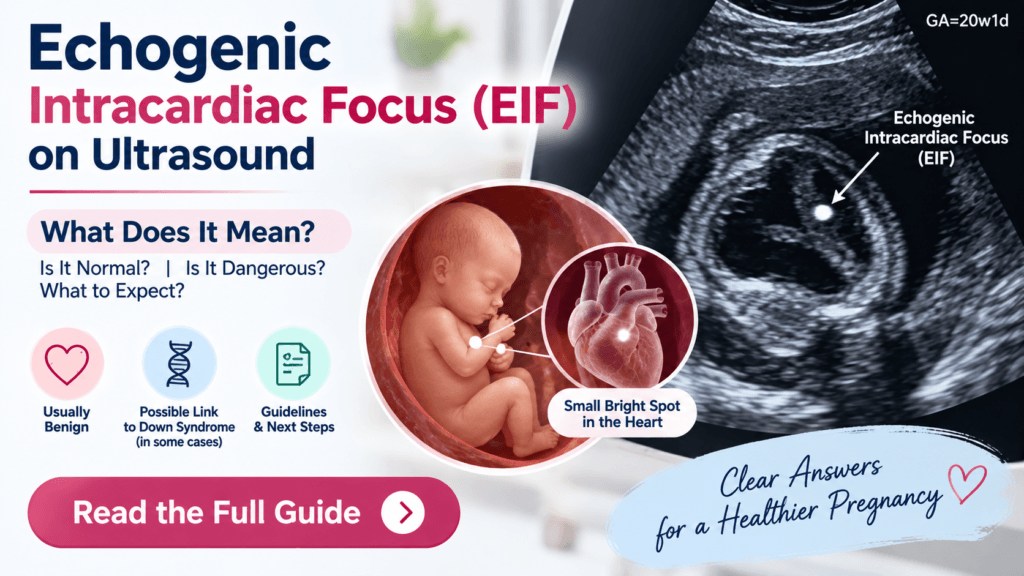
An echogenic intracardiac focus (EIF) is a small bright spot seen inside a baby’s heart during a prenatal ultrasound. It is most often detected during the second-trimester anatomy scan, usually around 18–22 weeks.
Hearing that something “bright” was found in the fetal heart can understandably be concerning. However, an EIF is usually not a heart defect and does not generally affect how the baby’s heart works.
An EIF can sometimes be considered a soft ultrasound marker for chromosomal conditions, particularly trisomy 21 (Down syndrome). But its importance depends heavily on whether it is isolated and whether prenatal genetic screening has already been performed. Current guidance from the Society for Maternal-Fetal Medicine (SMFM), supported by ACOG, states that an isolated EIF with negative serum or cell-free DNA screening is considered a normal variant and does not require additional evaluation.
Quick Answer
An echogenic intracardiac focus (EIF) is a small bright spot seen within the fetal heart on ultrasound. It is usually a benign finding and does not mean the baby has a heart problem.
If the EIF is isolated and genetic screening such as cell-free DNA (NIPT) is low risk, current U.S. guidelines generally recommend no additional testing or follow-up specifically because of the EIF.
What Is an Echogenic Intracardiac Focus?
An echogenic intracardiac focus, commonly abbreviated as EIF, is a small area inside the fetal heart that appears brighter than the surrounding heart tissue during an ultrasound.
It is commonly associated with increased reflectivity from a papillary muscle, often in the left ventricle.
The term can sound more serious than it actually is. “Echogenic” simply means that the structure reflects ultrasound waves strongly and therefore looks bright on the screen.
An EIF is generally considered a sonographic finding rather than a structural heart defect.
Research has found that isolated EIFs are relatively common in otherwise normal pregnancies.
What Does EIF Look Like on Ultrasound?
On a fetal ultrasound, an EIF appears as a small bright white spot within one of the heart chambers.
It may be seen during the routine second-trimester anatomy scan.
A report might say:
“Echogenic intracardiac focus is noted in the left ventricle.”
or:
“Isolated echogenic intracardiac focus is seen within the fetal heart.”
The word “isolated” is particularly important. It means that no other structural abnormality or additional ultrasound soft marker was identified on the detailed examination.
Is EIF a Heart Defect?
Usually, no.
An isolated EIF does not generally represent a hole in the heart, abnormal heart chambers, or a problem with the heart’s pumping function.
It is considered a normal variant when it is isolated and the rest of the fetal anatomy is normal, particularly when appropriate prenatal genetic screening is low risk.
Also Read : 6 Weeks 3 Days Ultrasound: What You Will Actually See on the Screen
SMFM specifically states that an isolated EIF with negative serum or cell-free DNA screening is a normal variant with no clinical importance and does not require fetal echocardiography, follow-up ultrasound, or postnatal evaluation solely because of the EIF.
Is EIF Common?
Yes. EIF is not a rare ultrasound finding.
Studies have reported EIF in several percent of pregnancies. In one large study, an isolated echogenic focus was found in approximately 4% of chromosomally normal fetuses.
The frequency can vary depending on the population being studied, gestational age, ultrasound technique, and other factors.
Because EIF is relatively common, finding one does not automatically indicate that something is wrong with the pregnancy.
Does EIF Mean Down Syndrome?
Not by itself.
EIF received attention because earlier research found an association between echogenic intracardiac foci and trisomy 21 (Down syndrome).
However, the clinical meaning of EIF depends on the mother’s underlying risk and other screening results.
An older study found that an isolated EIF did not significantly increase the risk of trisomy 21 in younger women or in patients without abnormal serum screening.
More recent U.S. guidance has changed how isolated soft markers are managed because modern prenatal screening—especially cell-free DNA screening—can provide much more effective risk assessment.
Therefore, an EIF should not be interpreted as a diagnosis of Down syndrome.
It is a screening marker, not a diagnostic test.
What Does “Isolated EIF” Mean?
“Isolated” means the EIF is the only notable ultrasound finding.
For example, an ultrasound may show:
- Normal fetal growth
- Normal brain
- Normal spine
- Normal kidneys
- Normal limbs
- Normal facial structures
- Normal-appearing heart anatomy
- No other soft markers
- One EIF
That would generally be described as an isolated EIF.
This distinction matters because an EIF accompanied by other ultrasound abnormalities may have a different clinical significance.
SMFM defines an isolated soft marker as one found without a fetal structural abnormality, growth restriction, or additional soft marker following a detailed obstetric ultrasound examination.
EIF With a Negative NIPT or Genetic Screening
This is generally the most reassuring situation.
If a patient has:
Isolated EIF + negative cell-free DNA/NIPT
current SMFM guidance recommends no further evaluation specifically for the EIF.
There is no indication for:
- Amniocentesis solely because of the EIF
- Fetal echocardiography solely because of the EIF
- Repeat ultrasound solely to monitor the EIF
- Postnatal testing solely because of an isolated EIF
SMFM’s recommendation was reaffirmed in 2025 and is supported by ACOG.
ACOG’s current guidance also states that when an isolated soft ultrasound marker such as an echogenic cardiac focus is found and aneuploidy screening has been performed with a low-risk result, no further risk assessment is needed.
What If Genetic Screening Has Not Been Done?
If an isolated EIF is found and the patient has not had prenatal aneuploidy screening, ACOG and SMFM recommend discussing available screening options.
Depending on the individual situation, options may include:
- Cell-free DNA screening (NIPT)
- Quad screening, when appropriate
- Diagnostic testing such as amniocentesis, depending on individual circumstances and preferences
ACOG currently describes cell-free DNA as the most sensitive and specific screening test for the common fetal aneuploidies, including trisomies 21, 18, and 13. However, cell-free DNA remains a screening test, not a diagnostic test.
A patient should discuss the available options with their obstetrician or genetic counselor rather than making decisions based on the EIF alone.
Does EIF Go Away?
Sometimes an EIF may no longer be visible on a later ultrasound.
However, the disappearance or persistence of an isolated EIF generally does not change pregnancy management when appropriate genetic screening is reassuring.
In other words, doctors typically do not need to perform repeated ultrasounds simply to check whether an isolated EIF has disappeared. SMFM specifically recommends no follow-up ultrasound for an isolated EIF when serum or cell-free DNA screening is negative.
Does EIF Affect the Baby?
An isolated EIF generally does not affect the baby’s heart function, growth, or development.
It is important to distinguish EIF from an actual structural heart abnormality.
If an ultrasound identifies a structural cardiac abnormality, that is a different situation and may require additional evaluation, including detailed ultrasound or fetal echocardiography depending on the finding.
An isolated EIF, however, is treated differently under current guidelines.
Does EIF Require a Fetal Echocardiogram?
Usually, no.
If the only finding is an isolated EIF and genetic screening is negative, SMFM recommends no fetal echocardiography solely because of the EIF.
A fetal echocardiogram may still be recommended if there is another reason, such as a suspected structural heart abnormality, certain maternal or family risk factors, or another clinical indication.
Therefore, the decision should be based on the complete ultrasound and pregnancy history.
When to Seek Medical Care
An isolated EIF itself usually does not cause symptoms and does not require emergency treatment.
Contact your pregnancy care provider if:
- Your ultrasound report contains other abnormalities in addition to EIF.
- Your genetic screening result is positive or high risk.
- You have not had prenatal genetic screening and want to discuss your options.
- Your provider recommends additional imaging or genetic counseling.
- You have other pregnancy symptoms that concern you.
If you have severe abdominal pain, heavy vaginal bleeding, fluid leakage, or another pregnancy emergency, seek prompt medical care regardless of the EIF finding.
Does EIF mean my baby has Down syndrome?
No. EIF is not a diagnosis of Down syndrome. Its significance depends on other ultrasound findings and the results of prenatal genetic screening.
Is an echogenic intracardiac focus dangerous?
Usually not. An isolated EIF is generally considered a benign ultrasound finding and does not usually affect the baby’s heart function.
Is an isolated EIF normal?
Yes. When an EIF is isolated and the rest of the detailed ultrasound is normal, it is generally considered a normal variant, especially when genetic screening is low risk.
Does EIF require a fetal echocardiogram?
An isolated EIF generally does not require a fetal echocardiogram. A fetal echocardiogram may be appropriate if another cardiac or pregnancy-related indication exists.
Can EIF disappear before birth?
Yes, an EIF may no longer be visible on a later ultrasound. However, follow-up imaging is generally not recommended solely to determine whether an isolated EIF disappears when genetic screening is reassuring.
What should I do if I have EIF but no NIPT?
Discuss prenatal screening options with your obstetrician. Current ACOG and SMFM guidance recommends counseling and offering appropriate aneuploidy screening when an isolated EIF is found without previous screening.

