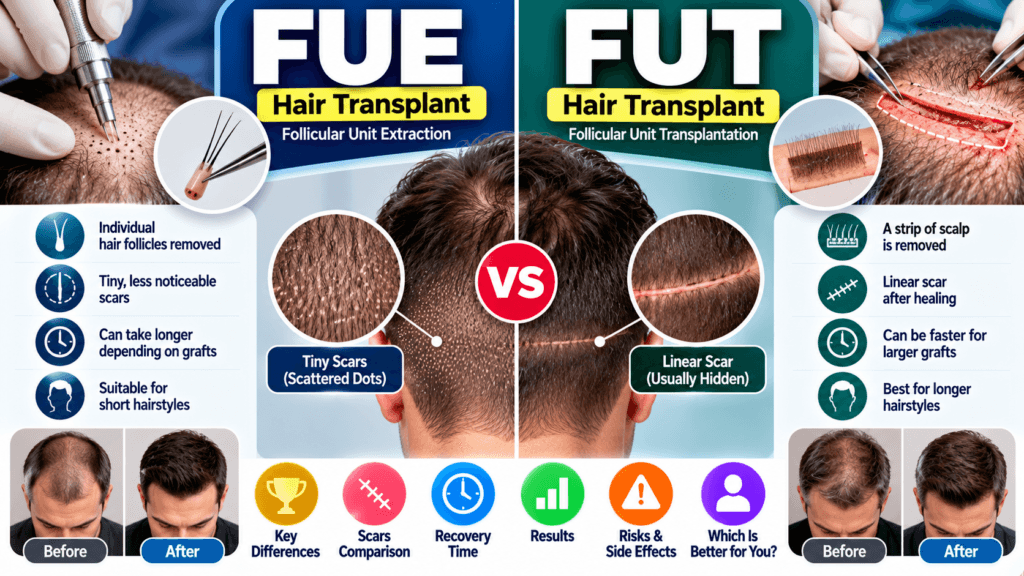
Hair loss can affect both appearance and confidence, especially when thinning becomes noticeable around the hairline, crown, or top of the scalp. Hair transplant surgery can permanently move healthy hair follicles from a donor area to areas affected by hair loss. Two of the most established donor-hair harvesting techniques are FUE (Follicular Unit Extraction) and FUT (Follicular Unit Transplantation).
Although both procedures ultimately transplant individual follicular units into thinning or bald areas, the main difference is how the donor hair is removed. FUE removes individual follicular units, while FUT removes a strip of hair-bearing scalp that is then divided into individual grafts. The best choice depends on factors such as your pattern of hair loss, donor hair characteristics, hairstyle preferences, available donor supply, and the surgeon’s assessment.
What Is FUE Hair Transplant?
FUE stands for Follicular Unit Extraction. During FUE, the surgeon removes individual follicular units from the donor area, usually from the back or sides of the scalp. These grafts are then prepared and transplanted into areas where hair is thinning or absent. Because individual grafts are removed rather than a strip of skin, FUE does not leave a single long linear donor scar. Instead, it produces numerous small scars that are generally less noticeable, particularly when the hair is kept at a short but not extremely close length.
FUE can take considerable time because the grafts are harvested individually. The overall procedure may take several hours depending on the number of grafts being transplanted and the treatment plan. Most hair transplant procedures are performed using local anesthesia, and patients generally remain awake during the surgery.
What Is FUT Hair Transplant?
FUT stands for Follicular Unit Transplantation. Instead of removing individual grafts one at a time, the surgeon removes a strip of hair-bearing scalp from the donor area. The strip is carefully divided into individual follicular-unit grafts, which are then transplanted into the recipient area.
Also Read : Vitamin D Deficiency Symptoms: Signs, Causes, Treatment & What to Do
The donor incision is closed with sutures, leaving a linear scar. The scar is usually concealed by the surrounding hair, but it may become visible if the hair is cut very short. FUT can be an appropriate option for selected patients, particularly when the surgeon believes strip harvesting is suitable for the person’s donor area and long-term hair restoration plan.
FUE vs FUT: Key Differences
| Feature | FUE | FUT |
|---|---|---|
| Full name | Follicular Unit Extraction | Follicular Unit Transplantation |
| Donor harvesting | Individual follicular units | Strip of hair-bearing scalp |
| Donor scar | Multiple tiny scars | Linear scar |
| Stitches | Usually not required for individual extraction | Required to close the strip incision |
| Short hairstyles | Generally more suitable | Linear scar may be more noticeable |
| Harvesting method | Individual graft extraction | Strip removal followed by graft preparation |
| Procedure time | Can be lengthy because grafts are extracted individually | Strip harvesting can be faster, depending on the case |
| Best choice | Depends on donor supply, goals and hairstyle | Depends on donor characteristics, goals and surgical plan |
Both techniques ultimately provide follicular-unit grafts for transplantation. The major difference is the method used to harvest those grafts from the donor area.
FUE vs FUT Hair Transplant Scarring
Scarring is one of the biggest differences between FUE and FUT. FUE produces many tiny scars spread across the donor area because individual follicular units are removed. These scars are generally small and may be difficult to see once the area heals, although the appearance can vary between individuals.
FUT produces a linear scar where the strip of scalp was removed. A skilled surgeon can usually position and close the incision so the scar is hidden by surrounding hair, but it can become visible with very short hairstyles. Your healing ability, surgical technique and individual scar formation can all affect the final appearance.
FUE vs FUT Recovery
Both procedures require a healing period, although the recovery experience can vary from person to person. After a hair transplant, temporary swelling, discomfort, itching, crusting or changes in sensation can occur. Most hair transplant procedures are performed on an outpatient basis, meaning patients can generally go home the same day.
FUT involves an incision that is closed with sutures, so the donor area needs to heal from that surgical wound. FUE does not involve removal of a strip, but the donor area contains numerous small extraction sites that also need time to heal. Your surgeon will provide specific instructions about washing your scalp, exercise, sleeping position and other activities during recovery.
Which Procedure Gives Better Results?
There is no universal answer that FUE always produces better results than FUT or vice versa. Both techniques can produce natural-looking hair restoration when performed appropriately by an experienced hair-transplant surgeon. The American Academy of Dermatology notes that modern hair transplantation can create natural-looking results by transplanting healthy hairs in small follicular units rather than the old-fashioned large hair plugs.
The final result depends on several factors, including the quality and density of donor hair, the extent of hair loss, the design of the hairline, graft placement, the surgeon’s technique and whether existing hair loss continues after surgery. It is also important to have realistic expectations because a transplant may create fuller-looking hair but cannot necessarily restore the density you had when you were younger.
Benefits of FUE Hair Transplant
One of the main advantages of FUE is the absence of a single long linear donor scar. Instead, the procedure leaves small extraction scars distributed throughout the donor area. This can be advantageous for people who prefer relatively short hairstyles.
FUE also allows individual follicular units to be selected during harvesting. However, it is a technically demanding procedure, can take substantial time, and is not automatically the best choice for every patient. Your surgeon should evaluate your donor area and long-term hair restoration goals before recommending the technique.
Benefits of FUT Hair Transplant
A major advantage of FUT is that the surgeon can harvest a strip of hair-bearing scalp and then divide it into individual follicular-unit grafts. This approach can be useful in selected patients depending on their donor characteristics and the amount of hair that needs to be transplanted.
Also Read : Thorne Vitamin B12 Methylcobalamin Review: Benefits, Uses, Dosage, and Side Effects
Because FUT leaves a linear scar, it may be less attractive for someone who regularly wears very short hairstyles. However, the scar can often be concealed by surrounding hair. Whether FUT is appropriate depends on the individual patient rather than a simple rule that one technique is always superior.
Risks and Possible Side Effects
Hair transplantation is a surgical procedure, so both FUE and FUT have potential risks. Possible complications include bleeding, infection, pain, swelling, temporary numbness or tightness, scarring, poor graft growth and an unnatural appearance.
Temporary shedding of transplanted hair can also occur after surgery. The American Academy of Dermatology notes that transplanted hairs commonly shed within the first several weeks, after which new growth gradually develops. Visible results often begin to appear several months after surgery, and some patients may need up to 12 months to see the full result.
Who May Be a Good Candidate for a Hair Transplant?
A good candidate generally needs enough healthy donor hair that can be moved to the thinning or bald area and enough recipient area that can support transplanted hair. The cause and pattern of hair loss are also important. A dermatologist or qualified hair-restoration surgeon may examine the scalp and, when appropriate, recommend additional testing to determine why hair loss is occurring.
People with progressive hair loss may be advised to stabilize or manage their hair loss medically before or alongside transplantation. This is important because a transplant moves existing donor hair but does not necessarily stop other non-transplanted hair from continuing to thin.
Can Hair Loss Continue After a Transplant?
Yes. A hair transplant does not necessarily stop the progression of natural hair loss in areas that were not transplanted. This is why some patients may be advised to continue appropriate medical treatment after surgery. The American Academy of Dermatology notes that hair-loss medicine can help slow or prevent additional thinning and may help maintain the appearance of the transplant over time.
FUE vs FUT Hair Transplant: Which Is Better?
The better procedure depends on your individual situation. FUE may be preferable if minimizing a linear scar and wearing shorter hairstyles are important priorities. FUT may be considered when strip harvesting is appropriate for the donor area and the surgeon believes it offers an advantage for the patient’s restoration plan.
Rather than choosing a procedure based only on advertisements or price, discuss your donor density, expected graft requirements, hair-loss progression, scar expectations and long-term treatment plan with a qualified hair-restoration surgeon. The surgeon’s experience and ability to create a natural hairline can be just as important as the harvesting technique itself.
This article is for educational and informational purposes only and is not a substitute for professional medical advice, diagnosis, or treatment. Always consult a qualified healthcare professional for advice about your individual health.