
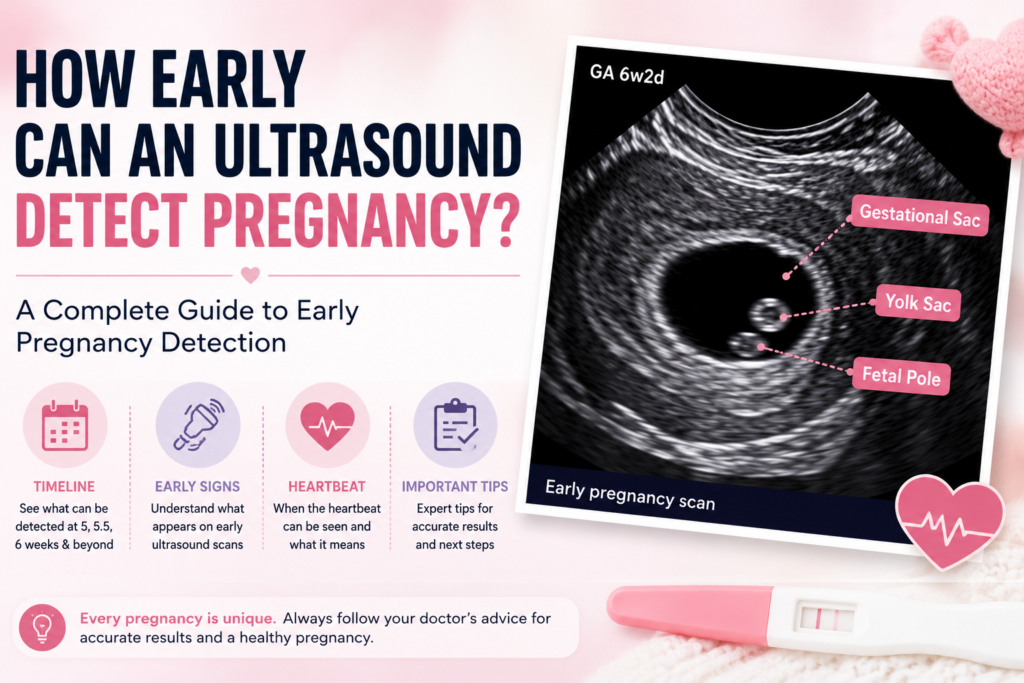
One of the most common questions women ask after getting a positive pregnancy test is, “How early can an ultrasound detect pregnancy?” Ultrasound technology plays an important role in confirming pregnancy and monitoring early fetal development. While home pregnancy tests detect pregnancy hormones, an ultrasound provides visual confirmation that a pregnancy is developing inside the uterus. Many women feel anxious during the early weeks and want reassurance that everything is progressing normally. Understanding when pregnancy can first be seen on ultrasound can help reduce confusion and unnecessary stress.
How Ultrasound Detects Pregnancy
An ultrasound uses sound waves to create images of the inside of the body. During early pregnancy, ultrasounds help doctors identify structures such as the gestational sac, yolk sac, fetal pole, and heartbeat. The ability to detect pregnancy depends on several factors including the type of ultrasound used, hormone levels, ovulation timing, and how far along the pregnancy actually is.
There are two main types of pregnancy ultrasounds: abdominal ultrasound and transvaginal ultrasound. A transvaginal ultrasound is more sensitive during very early pregnancy because the probe is placed closer to the uterus. This method can detect pregnancy earlier than a standard abdominal scan.
Earliest Time Pregnancy Can Be Seen on Ultrasound
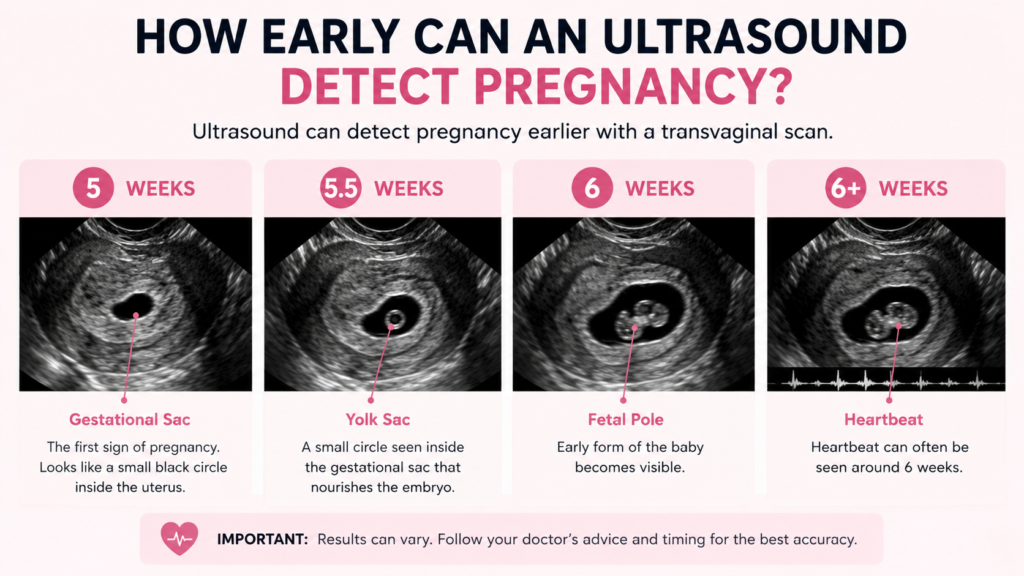
Pregnancy can usually be detected on a transvaginal ultrasound around 4.5 to 5 weeks of pregnancy. At this stage, the doctor may see a tiny gestational sac inside the uterus. The gestational sac is the first visible sign of pregnancy on ultrasound and appears as a small black circle.
However, it is important to understand that seeing nothing on an ultrasound before 5 weeks does not always mean there is a problem. Many pregnancies are simply too early to visualize clearly. Ovulation timing can vary from woman to woman, especially in those with irregular menstrual cycles.
What Can Be Seen at 5 Weeks Pregnant
Around 5 weeks pregnant, the gestational sac becomes more visible on ultrasound. In some pregnancies, the yolk sac may also appear during this stage. The yolk sac provides early nutrition to the developing embryo before the placenta fully forms.
At 5 weeks, the embryo itself is often too small to be seen clearly. Some women may only see the gestational sac, while others may see both the gestational sac and yolk sac. These findings are generally considered normal for early pregnancy.
What Can Be Seen at 6 Weeks Pregnant
By 6 weeks of pregnancy, ultrasound images usually provide more information. The fetal pole, which is the earliest visible form of the baby, may become visible next to the yolk sac. In many pregnancies, the heartbeat can also be detected around this time.
The heartbeat at 6 weeks typically ranges between 90 and 120 beats per minute. Seeing the heartbeat is often a major emotional milestone for expectant parents. However, not detecting a heartbeat at exactly 6 weeks does not always indicate pregnancy loss. Sometimes the pregnancy is earlier than expected due to delayed ovulation.
Can Pregnancy Be Detected Before 5 Weeks?
Detecting pregnancy before 5 weeks on ultrasound is very difficult. Even with advanced ultrasound equipment, the pregnancy structures are extremely tiny during this stage. Blood tests measuring hCG hormone levels are often more useful than ultrasound before 5 weeks.
Doctors sometimes monitor hCG levels every 48 hours to check whether the pregnancy is progressing normally. Rising hCG levels can suggest a developing pregnancy even before anything becomes visible on ultrasound.
Importance of hCG Levels in Early Ultrasound
The pregnancy hormone hCG plays a major role in determining when pregnancy can be detected on ultrasound. Typically, a gestational sac becomes visible on transvaginal ultrasound when hCG levels reach approximately 1,500 to 2,000 mIU/mL. However, this number can vary depending on the equipment and individual pregnancy.
Also Read : Oligohydramnios in Pregnancy – Low Amniotic Fluid Explained
Doctors often use both ultrasound findings and hCG levels together to evaluate early pregnancy. This combination helps determine whether the pregnancy is developing normally or if further monitoring is needed.
Why an Early Ultrasound May Show Nothing
Many women panic when an early ultrasound does not show a baby immediately. In reality, there are several possible reasons for this. The most common reason is that the pregnancy is earlier than expected. Late ovulation can significantly change gestational age calculations.
Other possible reasons include:
- Very early pregnancy
- Irregular menstrual cycles
- Incorrect pregnancy dating
- Low hCG levels
- Ectopic pregnancy
- Early pregnancy loss
Because of these possibilities, doctors often recommend repeating the ultrasound after one or two weeks if the initial scan is inconclusive.
Can Ultrasound Confirm an Ectopic Pregnancy Early?
One important purpose of early ultrasound is ruling out ectopic pregnancy. An ectopic pregnancy occurs when the embryo implants outside the uterus, usually inside the fallopian tube. This condition can become dangerous if untreated.
If hCG levels are high but no pregnancy is visible inside the uterus, doctors may suspect an ectopic pregnancy. Symptoms such as severe abdominal pain, shoulder pain, dizziness, or heavy bleeding require immediate medical attention.
Why Transvaginal Ultrasound Is Better in Early Pregnancy
A transvaginal ultrasound is considered the best option during very early pregnancy because it produces clearer and more detailed images. Since the embryo is extremely small during the first few weeks, abdominal ultrasounds may not detect it early enough.
During a transvaginal ultrasound, a thin probe is gently inserted into the vagina to obtain detailed images of the uterus and ovaries. Although some women feel nervous about the procedure, it is generally safe, quick, and not painful.
Emotional Experience of Early Pregnancy Ultrasound
The first ultrasound appointment can bring a mixture of excitement, nervousness, and hope. Many parents look forward to visual confirmation of the pregnancy after waiting for positive test results. Seeing the gestational sac or hearing the heartbeat for the first time often creates a strong emotional connection with the baby.
For women with a history of infertility or miscarriage, early ultrasounds may feel especially emotional. Anxiety is common during this stage because early pregnancy development can vary significantly between individuals.
How Accurate Is Early Pregnancy Ultrasound?
Early pregnancy ultrasounds are generally very accurate for determining gestational age and confirming pregnancy location. Ultrasound measurements taken during the first trimester are considered among the most reliable methods for estimating due dates.
However, accuracy depends heavily on timing. A scan performed too early may not provide enough information, which is why follow-up ultrasounds are often recommended in uncertain cases.
Preparing for an Early Pregnancy Ultrasound
Preparation for an early ultrasound depends on the type of scan being performed. For abdominal ultrasounds, doctors may ask patients to drink water beforehand so the bladder is full. A full bladder helps improve image quality during early pregnancy.
For transvaginal ultrasounds, a full bladder is usually unnecessary. Wearing comfortable clothing and remaining calm can help make the experience easier.
What Happens After the Ultrasound?
After the scan, the healthcare provider explains the findings and discusses the next steps. If the pregnancy appears healthy and appropriately developed for gestational age, the next prenatal appointment may be scheduled within a few weeks.
If the scan findings are uncertain, additional ultrasounds or blood tests may be recommended. Waiting for repeat scans can feel stressful, but early pregnancy development changes rapidly, and a short delay often provides much clearer answers.
Healthy Pregnancy Tips After Early Detection
Once pregnancy is confirmed, maintaining a healthy lifestyle becomes very important. Women should begin prenatal vitamins containing folic acid, stay hydrated, avoid smoking and alcohol, and attend regular prenatal care appointments.
Proper nutrition, adequate rest, and stress management also support healthy fetal development during the early weeks of pregnancy.

