
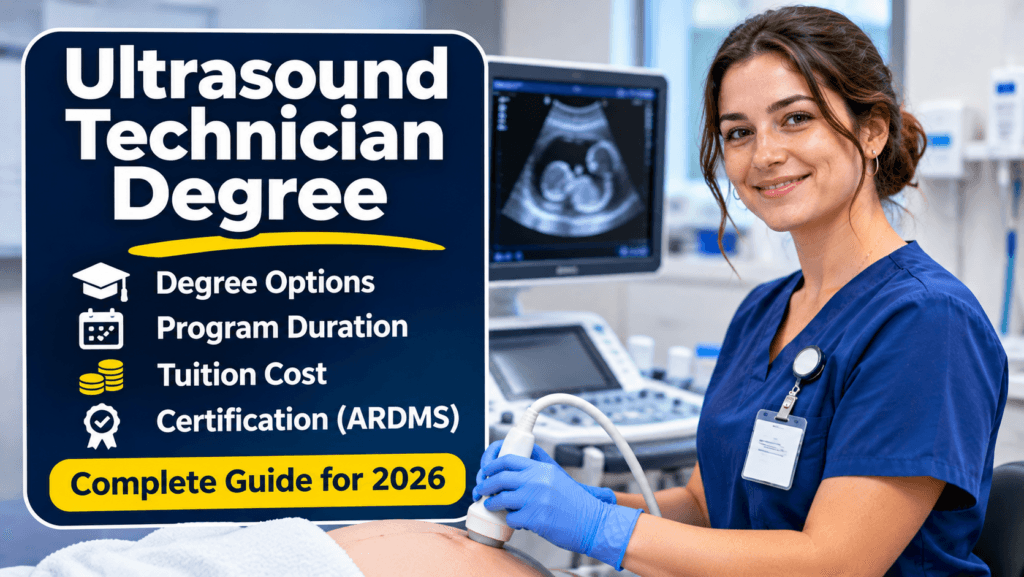
An ultrasound technician degree is a popular educational pathway for students who want to build a career in medical imaging in the United States. Ultrasound technicians, also known as diagnostic medical sonographers, use specialized equipment to create images of organs, tissues, blood vessels, and developing babies inside the body. Most entry-level positions require an associate degree in diagnostic medical sonography or an appropriate postsecondary certificate, along with the clinical skills needed to perform ultrasound examinations. If you are researching an ultrasound technician degree, this guide explains the available degree options, admission requirements, program duration, tuition costs, accredited schools, certification pathways, and career opportunities in the USA.
What Degree Do You Need to Become an Ultrasound Technician?
Most students pursue an Associate of Applied Science (AAS), Associate of Science (AS), or Associate of Occupational Studies (AOS) degree in Diagnostic Medical Sonography to become an ultrasound technician. These programs combine medical science, ultrasound physics, scanning techniques, patient care, and supervised clinical training. Some colleges also offer bachelor’s degrees in diagnostic medical sonography, which can provide additional academic preparation for advanced professional or leadership opportunities. According to the U.S. Bureau of Labor Statistics (BLS), diagnostic medical sonographers typically need an associate degree or a postsecondary certificate to enter the profession.
Common educational pathways include:
| Degree or Program | Typical Duration | Career Path |
|---|---|---|
| Associate Degree in Sonography | About 2 years | Entry-level sonographer |
| Bachelor’s Degree in Sonography | About 4 years | Sonography and advanced career opportunities |
| Postsecondary Certificate | Varies, often 12–24 months | Career pathway for eligible students |
| Post-Bachelor’s Certificate | Varies | Sonography specialization for eligible graduates |
The best degree depends on your previous education, career goals, and the certification eligibility requirements of your chosen program. For most students starting from high school, an accredited associate degree is a practical option.
Types of Ultrasound Technician Degrees
Colleges in the United States offer different educational pathways for people interested in diagnostic medical sonography. Understanding the differences can help you select a program that matches your budget, academic background, and long-term career plans.
Associate Degree in Diagnostic Medical Sonography
An associate degree is one of the most common educational routes into the ultrasound profession. Most programs take approximately two years after admission, although prerequisite courses can increase the total time required. Students learn anatomy, physiology, ultrasound physics, abdominal sonography, obstetrics and gynecology, and patient care. The program also includes supervised clinical rotations where students develop practical scanning skills in hospitals or medical imaging facilities.
Bachelor’s Degree in Diagnostic Medical Sonography
A bachelor’s degree generally takes around four years of full-time college study, depending on the institution and transfer credits. These programs combine sonography training with broader coursework in healthcare, science, professional development, and sometimes healthcare management. A bachelor’s degree may be useful for students interested in leadership, education, research, or further academic study. However, a bachelor’s degree is not universally required for entry-level ultrasound technician positions.
Certificate in Diagnostic Medical Sonography
Some colleges and hospitals offer postsecondary certificate programs for applicants who already hold a degree or have an appropriate healthcare education background. These programs may provide a more direct pathway into sonography than completing another full undergraduate degree. Admission requirements and program length vary significantly between institutions. Before applying, check whether the certificate is accredited and whether it meets the eligibility requirements for the professional credential you plan to pursue.
How Long Does an Ultrasound Technician Degree Take?
The time needed to earn an ultrasound technician degree depends on the type of program, prerequisite coursework, and clinical training requirements. A traditional associate degree generally takes about two years after students enter the professional program, while a bachelor’s degree usually requires around four years. Some colleges require students to complete general education and science prerequisites before applying to the sonography program. Clinical rotations are an essential part of the education and must be completed in person at approved healthcare facilities.
| Education Pathway | Approximate Time |
|---|---|
| Associate Degree | 2 years |
| Bachelor’s Degree | 4 years |
| Certificate Program | 1–2 years, depending on eligibility |
| Prerequisite Coursework | Varies by college |
| Post-Bachelor’s Certificate | Varies by institution |
For example, Northern Virginia Community College offers a two-year Associate of Applied Science program in Diagnostic Medical Sonography. Students can choose specializations such as abdominal sonography, obstetrics and gynecology, echocardiography, and vascular sonography.
Ultrasound Technician Degree Requirements: Who Can Apply?
Admission requirements for ultrasound technician degree programs differ by college, but most schools expect applicants to have a high school diploma or GED. Students may also need to complete prerequisite courses in anatomy, physiology, mathematics, English, and general science before entering the professional sonography program. Because these programs include direct patient care, colleges often require background checks, health screenings, immunization records, and CPR certification. Some schools use competitive admission processes because clinical placement opportunities and available student seats are limited.
Phlebotomy Training in the USA: Classes, Cost, Free Programs, and Certification (2026)
Common admission requirements include:
- High school diploma or GED.
- Minimum GPA specified by the college.
- Prerequisite courses in biology, anatomy, and mathematics.
- Official academic transcripts.
- College entrance or placement requirements, if applicable.
- Background check and drug screening.
- Immunization and health documentation.
- CPR or Basic Life Support certification, if required.
- Personal interview or entrance assessment at some institutions.
Meeting the minimum admission requirements does not guarantee acceptance into a competitive sonography program. Contact the college’s admissions office to understand its current selection process and application deadlines.
What Do You Learn in an Ultrasound Technician Degree Program?
An ultrasound technician degree combines classroom instruction, laboratory practice, and supervised clinical experience. Students learn how to operate ultrasound equipment, obtain diagnostic images, recognize normal anatomy, and identify image features that may require further evaluation by a physician. The curriculum also covers patient communication, medical ethics, infection prevention, and safe scanning practices. Clinical rotations allow students to apply their knowledge while working with patients under the supervision of qualified sonographers and healthcare professionals.
| Course or Subject | What You Learn |
|---|---|
| Human Anatomy | Organs, tissues, and body structures |
| Physiology | How the human body functions |
| Ultrasound Physics | Sound waves, frequency, and image formation |
| Abdominal Sonography | Imaging of abdominal organs |
| Obstetrics and Gynecology | Pregnancy and pelvic ultrasound |
| Vascular Sonography | Blood vessels and blood flow |
| Echocardiography | Ultrasound imaging of the heart |
| Patient Care | Patient preparation and communication |
| Medical Ethics | Privacy, safety, and professional responsibilities |
| Clinical Practicum | Supervised hands-on ultrasound examinations |
Some programs offer a general sonography curriculum, while others provide separate tracks for abdominal, OB/GYN, cardiac, and vascular imaging. Review the program’s accredited concentration before choosing a specialization.
Ultrasound Technician Degree Cost: How Much Does It Cost?
The cost of an ultrasound technician degree varies depending on the college, state residency, program length, and additional clinical expenses. Public community colleges may be more affordable for in-state students, while private colleges and out-of-state tuition can be considerably higher. Students should also budget for textbooks, uniforms, ultrasound laboratory fees, background checks, immunizations, transportation to clinical sites, and certification examination fees. Instead of relying on a single national average, compare the published total program costs of individual colleges before making a decision.
Here are examples of published program costs for the 2026–2027 academic year:
| College | Program | Published Cost |
|---|---|---|
| Tarrant County College, Texas | AAS Diagnostic Medical Sonography | $4,810 |
| Miami Dade College, Florida | AS Diagnostic Medical Sonography | $9,102.94 |
| Tri-C, Ohio | Associate Degree | $10,599–$11,695 in-county |
| Lansing Community College, Michigan | DMS Associate Degree | Approximately $23,216.25 in-district |
These figures have different coverage and residency assumptions, so they are not directly comparable. For example, Tarrant County College’s published amount is based on in-state, in-county tuition and fees and excludes textbooks and other materials. Always check the latest college fee schedule before applying.
Best Accredited Ultrasound Technician Degree Programs in the USA
Choosing an accredited ultrasound technician degree program is an important step toward building a successful career. Programmatic accreditation helps students identify educational programs that meet recognized professional standards and may provide a direct route toward certification examination eligibility. The Commission on Accreditation of Allied Health Education Programs (CAAHEP) accredits diagnostic medical sonography programs upon the recommendation of the Joint Review Committee on Education in Diagnostic Medical Sonography (JRC-DMS). Students should verify the exact campus and sonography concentration rather than relying only on a college’s general accreditation.
Some examples of colleges and institutions offering accredited sonography education include:
1. Northern Virginia Community College (NOVA)
NOVA offers a two-year Associate of Applied Science degree in Diagnostic Medical Sonography. Students can choose from abdominal and obstetrics and gynecology, echocardiography, and vascular sonography pathways. The program includes professional coursework and clinical preparation, and its accredited concentrations provide routes toward the relevant professional certification examinations.
2. Miami Dade College
Miami Dade College offers an Associate in Science degree in Diagnostic Medical Sonography. The program includes technical sonography coursework and clinical learning experiences designed to prepare students for professional imaging careers. The college publishes an estimated tuition cost of $9,102.94 and an estimated completion time of three years for its listed program pathway.
3. Tarrant County College
Tarrant County College offers an Associate of Applied Science degree in Diagnostic Medical Sonography. Its program is accredited by CAAHEP upon the recommendation of JRC-DMS. For the 2026–2027 academic year, the college lists $4,810 in total tuition and fees for eligible in-county students, excluding textbooks and other materials.
4. Lansing Community College
Lansing Community College offers an Associate of Applied Science degree in Ultrasound: Diagnostic Medical Sonography. Students receive academic and clinical training and may become eligible to pursue professional examinations through ARDMS or ARRT, subject to the applicable requirements. The college estimates a 2026–2027 in-district program cost of approximately $23,216.25, including program-related supplies and textbooks.
5. University of Arkansas for Medical Sciences (UAMS)
UAMS offers a Bachelor of Science in Diagnostic Medical Sonography. The program is accredited by CAAHEP upon the recommendation of JRC-DMS and provides a bachelor’s-level educational pathway for students interested in sonography. Students should review the university’s current admissions requirements, program structure, and available concentrations before applying.
Online Ultrasound Technician Degree: Can You Study Online?
An online ultrasound technician degree can be attractive to students who want flexible learning while managing work or family responsibilities. Some colleges offer online or hybrid coursework for subjects such as anatomy, physiology, medical terminology, and ultrasound physics. However, becoming a competent diagnostic medical sonographer requires practical scanning experience and supervised clinical education. A fully online course without hands-on training and clinical placements is generally not an adequate substitute for a professional sonography degree program.
Before enrolling in an online or hybrid program, check the following:
- Whether the program is CAAHEP-accredited.
- Whether clinical rotations are included.
- Where practical ultrasound training takes place.
- Whether graduates meet ARDMS or other credentialing eligibility requirements.
- Whether the degree is recognized by employers in your intended state.
The most important consideration is not whether a program is advertised as online, but whether it provides the education, clinical training, and credentialing pathway needed for professional practice.
Ultrasound Technician Certification: Is ARDMS Required?
The American Registry for Diagnostic Medical Sonography (ARDMS) is one of the best-known professional credentialing organizations for sonographers in the United States. Although certification and licensing rules vary by state and employer, many healthcare facilities prefer or require professional credentials. The Registered Diagnostic Medical Sonographer (RDMS) credential is commonly pursued by professionals working in abdominal and obstetric and gynecologic ultrasound. Candidates generally need to meet an approved prerequisite and pass the required Sonography Principles and Instrumentation (SPI) and specialty examinations.
Common ARDMS credentials include:
| Credential | Specialty |
|---|---|
| RDMS | Diagnostic Medical Sonography |
| RDCS | Diagnostic Cardiac Sonography |
| RVT | Vascular Technology |
| RMSKS | Musculoskeletal Sonography |
The exact examination pathway depends on the candidate’s education and experience. Graduating from an appropriately accredited program can help establish eligibility for professional examinations, but applicants should always confirm their individual eligibility directly with ARDMS.
What Is the Difference Between an Ultrasound Technician and a Sonographer?
The terms ultrasound technician and diagnostic medical sonographer are often used interchangeably in the United States. Both generally refer to professionals who operate ultrasound equipment to create medical images for physicians. However, diagnostic medical sonographer is the formal occupational title used by the U.S. Bureau of Labor Statistics. Sonographers need strong knowledge of anatomy, ultrasound physics, patient care, and image acquisition. Their work involves obtaining diagnostic-quality images and communicating relevant technical information to the interpreting physician.
Ultrasound Technician Salary and Job Outlook in the USA
An ultrasound technician degree can lead to a well-paying healthcare career in the United States. According to the U.S. Bureau of Labor Statistics, diagnostic medical sonographers earned a median annual salary of $96,590 in May 2025, equivalent to approximately $46.44 per hour. Actual earnings depend on experience, specialization, location, employer, and work setting. Outpatient care centers reported a median annual wage of $127,940, while hospitals reported $97,390 in the same BLS data.
| Salary Measure | Diagnostic Medical Sonographers |
|---|---|
| Median annual salary | $96,590 |
| Median hourly wage | $46.44 |
| Lowest 10% earned less than | $67,820 |
| Highest 10% earned more than | $129,370 |
| Outpatient care center median | $127,940 |
| Hospital median | $97,390 |
These are national occupational wage figures, not guaranteed starting salaries for new graduates. Your actual pay may be lower or higher depending on your education, certification, experience, and local job market.
Job Outlook for Ultrasound Technicians
The employment outlook for diagnostic medical sonographers is strong. The BLS projects employment to grow 14% between 2025 and 2035, which is much faster than the projected average growth for all occupations. Approximately 6,000 openings are expected each year over the decade. An aging population and the expanding use of ultrasound in different medical specialties are among the factors supporting continued demand for qualified sonographers.
Career Opportunities After an Ultrasound Technician Degree
Graduates of diagnostic medical sonography programs can pursue employment in different healthcare environments. The career options available depend on the concentration completed, clinical experience, professional credentials, and employer requirements. Some sonographers specialize in pregnancy and pelvic imaging, while others focus on abdominal organs, vascular examinations, or cardiac ultrasound. Additional experience and professional education can also create opportunities in education, department leadership, and advanced imaging roles.
Common career options include:
- Diagnostic Medical Sonographer.
- Obstetric and Gynecologic Sonographer.
- Abdominal Sonographer.
- Cardiac Sonographer.
- Vascular Technologist.
- Breast Sonographer.
- Pediatric Sonographer.
- Sonography Clinical Instructor.
Final Thoughts on Ultrasound Technician Degree
An ultrasound technician degree can provide a strong foundation for a rewarding healthcare career in the United States. For most new students, an accredited associate degree in diagnostic medical sonography is a practical route into the profession, while a bachelor’s degree may be suitable for those seeking broader academic or career opportunities. Before choosing a college, compare tuition, program duration, clinical training, accreditation, and certification eligibility. With the right education and professional credentials, graduates can pursue opportunities in hospitals, outpatient imaging centers, physician offices, and specialized medical facilities.
This article is for educational and informational purposes only and is not a substitute for professional medical advice, diagnosis, or treatment. Always consult a qualified healthcare professional for advice about your individual health.