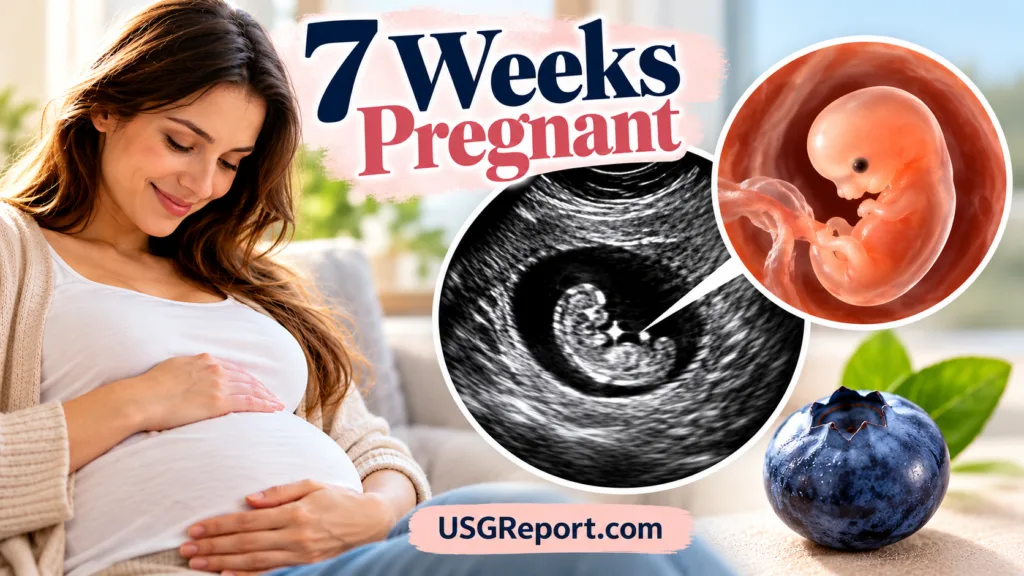

At 8 weeks pregnant, you are completing your second month, and your baby is about the size of a raspberry, roughly 1.6 centimeters long. The heart is beating strongly, fingers and toes are forming, and the face is starting to look more human, with a nose, upper lip, eyelids, and ears. For many people, this is also the week of the first prenatal visit and the first ultrasound, which brings excitement and a fair amount of nerves. Symptoms such as nausea, tiredness, and bloating are often in full swing as well. This guide explains your baby’s development at 8 weeks pregnant, what your first ultrasound checks and how to read the report, what happens at your first prenatal visit, and which symptoms need a call to your doctor.
What Is Happening at 8 Weeks Pregnant?
Pregnancy is counted from the first day of your last menstrual period, so at 8 weeks pregnant the embryo is about six weeks old. This is a period of very rapid growth, and by around week 8 most of the major organs and body systems have begun to form. Your hormones are high, your blood volume is starting to increase, and your uterus has grown to roughly the size of a large orange, although you may not look pregnant yet. Some people notice that their clothes feel a little tighter, mostly from bloating, while others see no change at all, and both are normal.
Important: Your due date is calculated from your last period, but an early ultrasound can adjust it if the baby’s measured size gives a different date. This is routine and nothing to worry about.
Baby Size at 8 Weeks Pregnant
At 8 weeks, your baby is about the size of a raspberry, which is just over half an inch or roughly 16 millimeters, measured from the top of the head to the bottom, called the crown-rump length (CRL). The embryo is uncurling from the C shape it had a week ago, and the limbs are longer and more defined. Normal sizes vary a little depending on the exact day of pregnancy, and the CRL is the most accurate way to date a first-trimester pregnancy, usually within about 5 to 7 days.
| Week | Typical size | Fruit comparison |
|---|---|---|
| 6 weeks | About 2 to 5 mm | Lentil |
| 7 weeks | About 1 cm | Blueberry |
| 8 weeks | About 1.6 cm | Raspberry |
Baby Development at 8 Weeks Pregnant
| Body part | What is happening at 8 weeks |
|---|---|
| Face | The nose and upper lip are identifiable, eyelids are forming, and the ears are developing |
| Fingers and toes | Fingers and toes are forming and are still webbed, and they become more distinct over the coming weeks |
| Arms and legs | The limbs are lengthening, and the arms may start to move, though you will not feel it |
| Heart | The heart beats strongly and continues to develop its chambers |
| Brain | The brain continues to grow rapidly and take shape |
| Organs | The lungs, kidneys, liver, and digestive system continue to develop |
| Intestines | Part of the intestines grows into the umbilical cord for a while, which is normal and temporary |
| Tail | The small tail-like structure seen earlier is disappearing |
In everyday talk, people often call the baby a fetus around now, but medically the baby is still called an embryo until about 10 weeks of pregnancy, when the main organs have formed and the fetal period begins. Whichever word you use, your baby is not yet making movements that you can feel, since the movements are very small and the uterus is still tucked low in the pelvis.
Your Baby’s Heartbeat at 8 Weeks
By 8 weeks, the heartbeat is stronger and faster than it was at 6 weeks. Many sources describe a rate of roughly 150 to 170 beats per minute at this stage, and the heart rate typically peaks around 9 to 10 weeks, in the range of about 170 to 180 beats per minute, before settling to a lower rate later in pregnancy. Figures differ a little between studies and machines, so a single number is less important than the overall pattern. The heartbeat is seen as a flicker on the screen on an ultrasound scan, and sometimes a clinic will play the sound with a Doppler on a later scan.
Your First Ultrasound at 8 Weeks
An ultrasound at around 8 weeks is a common first scan, and it is usually a transvaginal scan, because the embryo is small and the probe gives a clearer picture than a scan through the belly. The scan uses sound waves, not radiation, and is considered safe in pregnancy when it is done by a trained professional. If a scan is done at this stage, the sonographer will look at four main things.
First, they confirm where the pregnancy is, which should be inside the uterus. This also helps rule out an ectopic pregnancy. Second, they count the embryos, since this may be the first time that twins or more are seen. Third, they measure the crown-rump length, which gives the most reliable dating and may adjust your due date. Fourth, they check for the heartbeat and record the heart rate. They will also note the gestational sac and the yolk sac, which is the small ring beside the embryo, and look at the ovaries and the area around the uterus.
The image will not look like a baby just yet. At 8 weeks you will see a small, bean-shaped embryo, possibly with early limb buds, and a flickering heartbeat. Not everyone has a scan at 8 weeks, and some providers wait until 11 to 13 weeks for the first routine scan, but an earlier scan is common if you have pain or bleeding, have had fertility treatment, have had an ectopic pregnancy, or are unsure of your dates.
How to Read Your 8-Week Ultrasound Report
| Phrase in the report | What it means |
|---|---|
| Single live intrauterine pregnancy | One embryo with a heartbeat is growing inside the uterus |
| Gestational sac, mean sac diameter (MSD) in mm | The size of the fluid-filled sac, which should grow steadily |
| Yolk sac seen | The yolk sac is present, which is a reassuring early sign |
| CRL in mm, corresponding to 8 weeks and a few days | The embryo’s measured size and the age it suggests |
| Cardiac activity present, FHR in bpm | The heartbeat was seen, and the rate was recorded |
| EDD by CRL | Estimated due date based on the embryo’s size |
| Subchorionic hematoma or hemorrhage | A small collection of blood near the sac that is fairly common and often resolves |
| Corpus luteum cyst | A normal hormone-producing cyst on the ovary that supports early pregnancy |
| No adnexal mass, no free fluid | The tubes and ovaries look normal |
The wording and numbers vary between clinics, so ask your doctor to go through your own report with you.
Tip: Write your questions down before the visit and bring your report to every appointment. Early scans can feel overwhelming, and it is easy to forget what you meant to ask.
Your First Prenatal Visit
Many providers schedule the first prenatal visit between 8 and 10 weeks, and you should call as soon as you have a positive test, earlier if you have health conditions. At the visit, your doctor or nurse practitioner will confirm the pregnancy and estimate your due date, review your medical, family, and medication history, and do a physical exam, including a blood pressure check. You will usually have blood tests and a urine test, and these commonly include your blood type and Rh factor, a blood count, immunity to rubella, and screening for infections such as hepatitis B, HIV, and syphilis. If it is due, you may also have a Pap test. Your provider will discuss prenatal vitamins, nutrition, safe medicines, and lifestyle, and will plan your care. In a typical low-risk pregnancy, visits then happen about once a month until 28 weeks, then more often.
Symptoms at 8 Weeks Pregnant
| Symptom | What to know |
|---|---|
| Nausea and vomiting | Often at its worst between 8 and 12 weeks, and can happen at any time of day |
| Tiredness | Rising progesterone and blood volume can make you very sleepy |
| Breast tenderness | Breasts may feel heavy, sore, and larger |
| Frequent urination | The growing uterus presses on the bladder |
| Bloating and constipation | Hormones slow digestion |
| Heartburn and gas | Common as digestion slows |
| Mild cramps | Mild period-like cramps can be normal as the uterus stretches |
| Mood swings | Hormones and tiredness can make emotions swing |
| Food aversions and cravings | Strong smells and tastes may set off nausea |
To ease nausea, eat small, frequent meals, keep plain crackers by the bed, sip fluids throughout the day, and avoid foods and smells that trigger it. Some people find ginger helpful, and ACOG recommends vitamin B6, with or without doxylamine, as the first-line medicine, so ask your provider before using anything. For constipation, drink more fluid and eat more fiber. Most people gain only a few pounds in the first trimester, and some lose a little because of nausea. Call your provider if you cannot keep fluids down, are losing weight, or feel dizzy, since severe vomiting can need treatment.
What to Do at 8 Weeks Pregnant
Keep taking a daily prenatal vitamin with folic acid, because the CDC recommends at least 400 micrograms of folic acid a day to help prevent neural tube defects. Avoid alcohol, tobacco, and recreational drugs, keep caffeine under 200 milligrams a day, and check every medicine and supplement with your provider. Practice food safety by cooking meat and eggs thoroughly, washing produce, and avoiding unpasteurized dairy. Stay hydrated, rest when you can, and keep up gentle exercise such as walking if your provider agrees. If you feel anxious, it can help to talk with your partner, a friend, or your provider, since early pregnancy is often both exciting and stressful.
10 Best Foods to Increase Baby Weight During Pregnancy Naturally
When to Call Your Doctor
Call your provider promptly if you have heavy bleeding, severe or one-sided abdominal pain, shoulder pain, dizziness or fainting, or a fever. These can signal an ectopic pregnancy or another problem that needs urgent care. Light spotting is common in early pregnancy, but let your provider know so they can advise you.
Final Thoughts on 8 Weeks Pregnant
At 8 weeks pregnant, your baby is the size of a raspberry, with a strong heartbeat, forming fingers and toes, and a face that is taking shape. A first ultrasound this week usually confirms the pregnancy is in the uterus, counts the embryos, measures the CRL to set your due date, and records the heartbeat. Book your first prenatal visit, keep taking your prenatal vitamin, and look after yourself as symptoms peak. Next week, you will learn what changes at 9 weeks pregnant.
This article is for educational and informational purposes only and is not a substitute for professional medical advice, diagnosis, or treatment. Always consult a qualified healthcare professional for advice about your individual health.