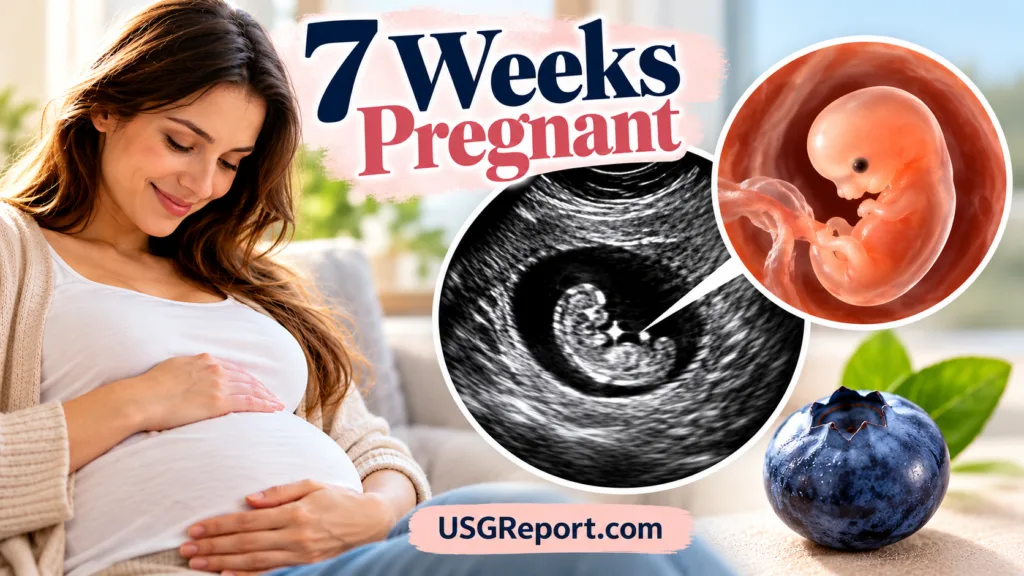

6 weeks pregnant is the week many people have been waiting for, because it is when the embryo’s heart starts to beat and an early ultrasound can often show it for the first time. Your baby is still tiny, about the size of a lentil, but a great deal is happening: the heart is pulsing, the brain and spine are forming, and tiny buds that will become arms and legs are beginning to appear. At the same time, your own body is changing, and morning sickness, tiredness, and sore breasts often become more noticeable. This guide explains your baby’s development at 6 weeks pregnant, what a heartbeat scan shows, what a normal heart rate is, how to read the common phrases in an early ultrasound report, and what to do if a heartbeat is not seen yet.
Series navigation: Previous week: 5 Weeks Pregnant | Next week: 7 Weeks Pregnant
What Is Happening at 6 Weeks Pregnant?
Pregnancy is counted from the first day of your last menstrual period, so at 6 weeks pregnant the embryo is actually about four weeks old. Since implantation, the embryo has been growing quickly and the placenta has begun to form to carry oxygen and nutrients from you to your baby. Levels of the pregnancy hormone hCG continue to climb, and the hormone progesterone rises too, which helps explain why nausea, fatigue, and breast tenderness often peak over the coming weeks. Because the embryo is so small, you will not have a visible bump yet.
Important: Early pregnancy dates are estimates. If your cycles are irregular or you ovulated later than usual, your baby may be a few days younger than your calendar suggests, which can change what an ultrasound shows.
Baby Development at 6 Weeks Pregnant
At 6 weeks, the embryo measures roughly 2 to 5 millimeters from head to bottom, about the size of a lentil, and it has a curved, C-shaped body. The rate of growth at this stage is rapid, with the embryo gaining roughly a millimeter a day. The table below summarizes what is developing.
| Body part | What is happening at 6 weeks |
|---|---|
| Heart | The primitive heart tube starts to pulse and begins forming its chambers |
| Brain and spine | The neural tube, which becomes the brain and spinal cord, closes during the first month after conception, and the brain starts to divide into regions |
| Face | Tiny pits that will become eyes, ears, and nostrils begin to take shape |
| Arms and legs | Small limb buds start to appear around this time |
| Organs | Early lungs, liver, and digestive tract begin to form |
| Placenta and cord | The placenta and umbilical cord are developing and starting to work |
Because the neural tube forms so early, folic acid matters even before you know you are pregnant. The CDC recommends 400 micrograms of folic acid daily for everyone who could become pregnant, and a prenatal vitamin usually covers this.
Your Baby’s Heartbeat at 6 Weeks
The first heartbeat is a small tube-shaped heart pulsing rhythmically, and it can often be seen on a transvaginal ultrasound as a flicker around 6 weeks. This is not yet the thumping sound people picture. The embryo is far too small for a stethoscope to pick up, and the first sign is a visual flicker on the screen. The heart rate starts out relatively slow, then rises quickly in the following weeks. Some embryos show cardiac activity a little earlier and others a little later, which is why 6 weeks is described as a typical time and not an exact moment.
What a 6-Week Heartbeat Scan Shows
A first scan at around 6 weeks is usually done transvaginally, because the probe sits closer to the uterus and produces a clearer image of such a small embryo. A transabdominal scan can also be used, but it often cannot show the early structures until a little later. The sonographer will look for a series of landmarks in order. First comes the gestational sac inside the uterus, then the yolk sac, a small bright ring inside the sac that nourishes the embryo early on. Next is the fetal pole, the first visible sign of the embryo, which appears as a thickening along the edge of the yolk sac, and finally the flickering cardiac activity inside it. The sonographer also measures the embryo’s crown-rump length (CRL), from the top of the head to the bottom, which gives the most accurate estimate of gestational age in early pregnancy, with an accuracy of about five days.
When Should You Worry About Pregnancy Cramps? Warning Signs Every Mom Should Know
A scan this early uses sound waves, not radiation, and is considered safe when done by trained professionals. Most providers do not order a routine scan at 6 weeks unless there is a reason, such as pain, bleeding, fertility treatment, a past ectopic pregnancy, or uncertain dates.
Normal Fetal Heart Rate in Early Pregnancy
The heart rate of an embryo changes quickly, so a number only makes sense alongside the gestational age. Sources vary slightly, but the pattern is consistent.
| Gestational age | Typical heart rate |
|---|---|
| 6 weeks | About 90 to 115 beats per minute |
| 7 to 8 weeks | Rises rapidly week by week |
| 9 to 10 weeks | Peaks at about 140 to 180 beats per minute |
One study of 255 pregnancies found an average embryonic heart rate of about 116 beats per minute at 6 weeks, rising to about 172 at 10 weeks. A single slow reading at 6 weeks is rarely conclusive, since the rate climbs daily and errors in dating can make a normal rate look slow. Some guidelines consider a rate below about 80 beats per minute concerning, and in that case a repeat scan after several days is usual.
How to Read Your Early Ultrasound Report
Here are the phrases you are most likely to see on a 6-week report and what they mean in plain language.
| Phrase in the report | What it means |
|---|---|
| Single live intrauterine pregnancy | One embryo with cardiac activity is growing inside the uterus |
| Gestational sac seen, mean sac diameter (MSD) in mm | The size of the fluid-filled sac, which grows steadily |
| Yolk sac seen | The small ring inside the sac is present, which is a good early sign |
| Fetal pole seen, CRL in mm | The embryo is visible and has been measured, and this gives the dating |
| Cardiac activity present, FHR in bpm | A heartbeat was seen and the heart rate was recorded |
| EDD by CRL | The estimated due date calculated from the embryo’s size |
| Subchorionic hematoma | A small collection of blood near the sac, which is common and often resolves |
| Corpus luteum cyst in the ovary | A normal structure that produces progesterone in early pregnancy |
| No adnexal mass, no free fluid | The tubes and ovaries look normal |
The exact wording differs from lab to lab, so ask your doctor to go through your own report.
Tip: Bring your report to your first prenatal visit, and write down any questions before the appointment, because early scans can feel overwhelming.
What If No Heartbeat Is Seen at 6 Weeks?
Not seeing a heartbeat at 6 weeks does not automatically mean a problem. The most common reason is that the scan is simply too early or the dates are off by a few days. Guidelines are cautious for this reason. Cardiac activity is expected once the embryo’s crown-rump length reaches about 7 millimeters, and when the embryo is smaller than this and no heartbeat is seen, current practice is to repeat the scan at least seven days later before drawing any conclusions. Similarly, if the gestational sac is still small and no fetal pole is seen, a second scan a week later is recommended. Blood hCG tests may be repeated as well. It is natural to feel anxious while waiting, and it may help to remember that a repeat scan is routine.
Important: Call your doctor promptly if you have heavy bleeding, severe or one-sided pelvic pain, shoulder pain, or fainting, since these can signal an ectopic pregnancy or other problem.
Symptoms at 6 Weeks Pregnant
Many people notice symptoms strengthen at this stage. Morning sickness, which can happen at any time of day, often begins around week 6. Other common symptoms include tiredness, tender or swollen breasts, frequent urination, bloating, constipation, food aversions or cravings, and mood swings. Light spotting or mild cramping can happen, and some people feel few symptoms, which is normal too. To ease nausea, try small, frequent meals, keep crackers by your bed, sip fluids through the day, and avoid triggers such as strong smells. Some people find ginger helpful, and ACOG recommends vitamin B6, with or without doxylamine, as a first-line medicine, so ask your provider before taking anything. If you cannot keep fluids down, lose weight, or feel dizzy, call your provider, because severe nausea and vomiting can need treatment.
What to Do at 6 Weeks Pregnant
Book your first prenatal visit if you have not already, since many providers see patients at around 8 weeks, and continue taking a prenatal vitamin with folic acid. Avoid alcohol, tobacco, and recreational drugs, and keep caffeine under 200 milligrams a day. Check all medicines and supplements with your provider, eat balanced meals, and stay hydrated. Rest when you can, and keep up gentle exercise such as walking if your provider agrees. The FDA advises against using handheld fetal Doppler devices for entertainment at home, because untrained use can give false reassurance or false alarms, so leave heartbeat checks to your care team.
Final Thoughts on 6 Weeks Pregnant
At 6 weeks pregnant, your baby’s heart has begun to beat, the brain and spine are forming, and the first ultrasound landmarks, the gestational sac, yolk sac, fetal pole, and heartbeat, can often be seen. A normal heart rate is roughly 90 to 115 beats per minute at this stage, and it climbs quickly over the next few weeks. If a heartbeat is not seen yet, a repeat scan in about a week is the usual next step. Take your prenatal vitamin, look after yourself, and keep your appointments. Next week, you will learn what changes at 7 weeks pregnant.
This article is for educational and informational purposes only and is not a substitute for professional medical advice, diagnosis, or treatment. Always consult a qualified healthcare professional for advice about your individual health.