In vitro fertilization, usually called IVF, is a fertility treatment in which eggs are collected from the ovaries, fertilized with sperm in a laboratory, and the resulting embryo is placed in the uterus to try to achieve a pregnancy. It is the most widely used form of assisted reproductive technology in the United States, and it helps people facing blocked tubes, low sperm counts, endometriosis, age-related fertility decline, unexplained infertility, and many other situations. This guide explains how in vitro fertilization works step by step, what success rates look like by age, what it costs, how insurance fits in, and the risks to understand before you start.
What Is In Vitro Fertilization (IVF)?
The Latin phrase “in vitro” means “in glass,” which refers to fertilization happening in a lab dish instead of inside the body. During an IVF cycle, medications stimulate the ovaries to produce several mature eggs, the eggs are retrieved in a short procedure, and they are combined with sperm. The embryos are grown in the lab for several days, and one or more is transferred to the uterus. Extra healthy embryos can be frozen for later use. IVF can use your own eggs and your partner’s sperm, donor eggs or sperm, or a gestational carrier who carries the pregnancy for you.
Important: IVF is not a guarantee. Success depends heavily on the age of the person providing the eggs, the cause of infertility, and embryo quality, so ask any clinic to explain your personal chances.
Who Might Need IVF?
Doctors often recommend IVF when simpler treatments have not worked or are unlikely to work. Common reasons include blocked or damaged fallopian tubes, endometriosis, severe male factor infertility, ovulation disorders that do not respond to medication, diminished ovarian reserve, and unexplained infertility. Same-sex couples and single people may use IVF with donor sperm or eggs, and some people use it to avoid passing on a known genetic condition through embryo testing. As a general guide, people under 35 are usually advised to see a specialist after 12 months of trying without pregnancy, and people 35 or older after about 6 months, though your doctor may recommend acting sooner if there are known risk factors.
The IVF Process Step by Step
A typical IVF cycle takes about four to six weeks from the start of medications to the pregnancy test, although planning, testing, and a frozen transfer can stretch the full journey longer.
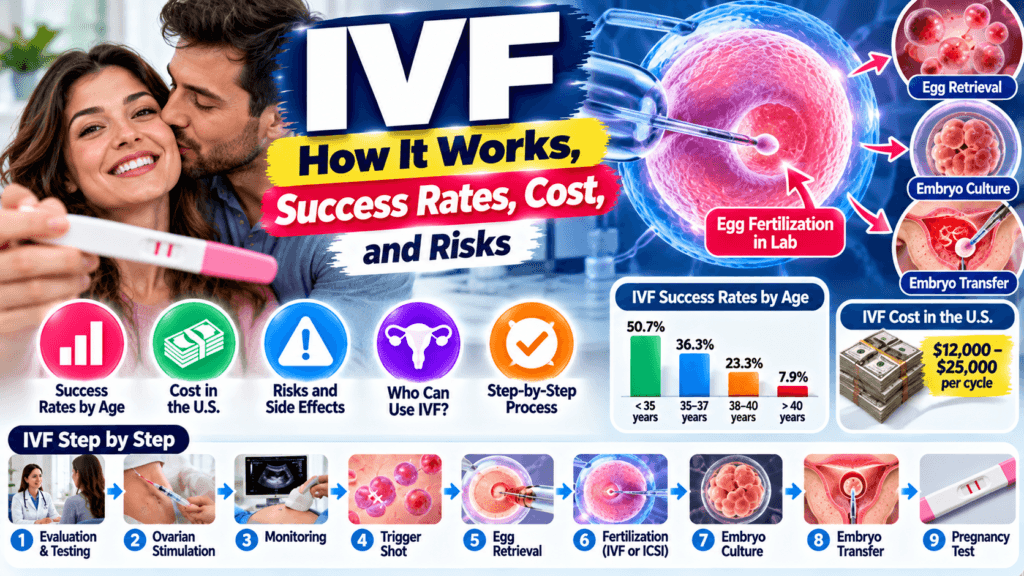
| Step | What happens |
|---|---|
| 1. Evaluation | Blood tests, ovarian reserve testing, ultrasound, semen analysis, and a review of your history |
| 2. Ovarian stimulation | Daily hormone injections for roughly one to two weeks to help several eggs mature |
| 3. Monitoring | Frequent ultrasounds and blood tests to track follicle growth and adjust doses |
| 4. Trigger shot | A final injection that matures the eggs, timed carefully before retrieval |
| 5. Egg retrieval | A short procedure under sedation using ultrasound guidance to collect the eggs |
| 6. Fertilization | Eggs are combined with sperm, or sperm is injected directly into an egg (ICSI) |
| 7. Embryo culture | Embryos grow in the lab for several days, often to the blastocyst stage |
| 8. Embryo transfer | A thin catheter places an embryo in the uterus, either fresh or in a later frozen cycle |
| 9. Pregnancy test | A blood test about 10 to 14 days after transfer |
Many clinics now freeze all embryos and transfer them in a later cycle, which gives the body time to recover from stimulation and allows genetic testing if you choose it. Preimplantation genetic testing (PGT) can screen embryos for chromosome problems or specific inherited conditions, but it is optional, adds cost, and randomized trials have not clearly shown that routine testing raises the cumulative chance of a live birth per egg retrieval. Discuss whether it makes sense for you.
Also Read : Echogenic Focus in Fetal Heart: What Does It Mean?
IVF Success Rates by Age
Age is the strongest predictor of IVF success. The table below shows figures from the CDC’s 2021 national ART summary for patients in each age group, and rates in newer reports from the CDC and the Society for Assisted Reproductive Technology (SART) differ somewhat depending on how success is counted.
| Age group | Live birth per intended egg retrieval | Live birth per embryo transfer |
|---|---|---|
| Under 35 | 50.7% | 49.1% |
| 35 to 37 | 36.3% | 44.8% |
| 38 to 40 | 23.3% | 40.2% |
| Over 40 | 7.9% | 24.4% |
The two columns answer different questions. Live birth per intended egg retrieval counts every fresh and frozen transfer that follows from one stimulation, so it reflects your chance of success from the start of a cycle. Live birth per transfer counts only people who reached the transfer stage. Rates per transfer fall more slowly with age because by then you already have a viable embryo, while the number of usable embryos from each retrieval drops steeply as age rises. The same CDC report estimates that the average number of intended retrievals needed per live birth rises from about 2 for patients under 35 to about 12.7 for patients over 40. When comparing clinics, look at results for your own age group and remember that clinics treating harder cases may post lower numbers.
Tip: Ask clinics for both live birth per retrieval and live birth per transfer for your age, plus their multiple pregnancy rate and how many cycles they perform each year.
How Much Does IVF Cost in the United States?
A single IVF cycle commonly costs between about $15,000 and $25,000 when medications and lab fees are included, with one 2026 estimate putting the average without insurance near $23,747. Fertility medications alone often add roughly $1,500 to $7,000 per cycle and are frequently billed separately from the clinic’s base fee. Extras such as ICSI, genetic testing, embryo freezing, annual storage, and frozen transfers add to the total. Because many people need more than one cycle, often two to three on average, the real cost of reaching a baby can be double or triple a single advertised price. Some manufacturer and federal discount programs for fertility drugs have been announced, so ask your clinic what is available now.
Does Insurance Cover IVF?
There is no federal requirement for insurers to cover IVF, so coverage depends on your state and your plan. Several states require some form of fertility coverage, and a smaller group, counted as 15 states plus the District of Columbia in one 2026 tracker, specifically require IVF coverage, although the counts differ by source and the rules often include limits on age, number of cycles, or diagnosis. Self-insured employer plans are typically exempt from state mandates, so even in a mandate state your employer’s plan may not cover IVF. Check your benefits booklet, call your insurer for the exact fertility benefit, and ask whether medications are covered. Many employers offer fertility benefits through third-party programs, and some clinics provide financing, shared-risk, or multi-cycle packages.
Also Read : Fetal Heart Rate at 9 Weeks: What Is Normal on Ultrasound?
Risks and Side Effects of IVF
Most people complete IVF without serious problems, but it is a medical treatment with real risks. Ovarian hyperstimulation syndrome (OHSS) can occur when the ovaries overrespond to medication, causing bloating, pain, and in severe cases fluid buildup that needs hospital care. Egg retrieval carries small risks of bleeding, infection, and anesthesia reactions. Multiple pregnancy, especially twins or more, raises the risk of preterm birth and complications, which is why single embryo transfer has become standard: SART reported single embryo transfer in about 74% of cycles in 2022. IVF pregnancies also have a slightly higher chance of ectopic pregnancy, and some studies link IVF with a modestly higher risk of complications such as preterm birth and low birth weight, partly due to underlying infertility. Common medication effects include bloating, mood swings, headaches, and injection-site bruising.
The emotional toll matters just as much. Waiting for results, financial pressure, and unsuccessful cycles can cause stress, anxiety, and grief, so build a support system early, consider counseling, and give yourself and your partner room to pause between cycles if you need it.
Important: Call your clinic right away if you develop severe abdominal pain, rapid weight gain, trouble breathing, heavy bleeding, fever, or very little urine after stimulation or retrieval.
How to Choose an IVF Clinic
Start with the data. SART and the CDC both publish clinic-level reports, and most U.S. clinics report to them. Look for physician credentials in reproductive endocrinology, transparent pricing, an honest conversation about your odds, and a track record with patients like you. Ask about the lab’s experience, cancellation rates, single embryo transfer policy, how they handle unused embryos, and who you will reach after hours. A second opinion is reasonable, particularly if you are told that IVF is your only option or if the plan seems more aggressive than your history warrants.
Tips to Prepare for an IVF Cycle
You cannot control everything, but healthy habits help. Aim for a healthy weight, avoid smoking and limit alcohol, take a prenatal vitamin with folic acid as your doctor advises, manage chronic conditions, and review all medications and supplements with your specialist. Plan time off around monitoring appointments and retrieval, and line up transportation for the sedation procedure. Keep a calendar of injection times and ask the nurse to demonstrate technique.
This article is for educational and informational purposes only and is not a substitute for professional medical advice, diagnosis, or treatment. Always consult a qualified healthcare professional for advice about your individual health.