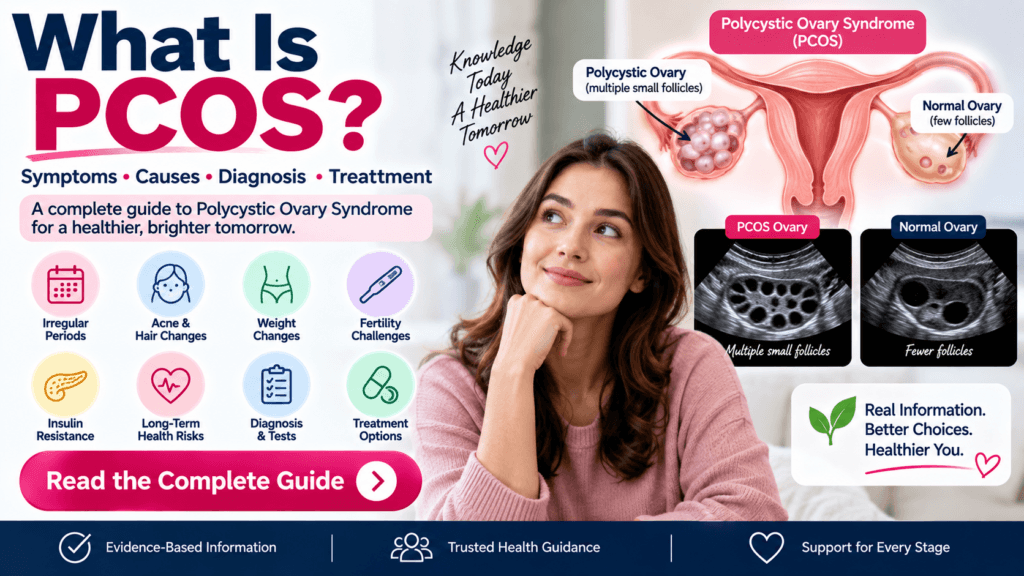
Polycystic ovary syndrome (PCOS) is a common hormonal and metabolic condition that can affect menstrual cycles, ovulation, fertility, skin, hair, and blood sugar regulation. PCOS is one of the common causes of infertility related to irregular or absent ovulation, but having PCOS does not mean you cannot become pregnant.
PCOS can look different from one person to another. Some women mainly have irregular periods, while others may experience acne, excess facial or body hair, scalp hair thinning, weight changes, or difficulty becoming pregnant.
PCOS is a condition involving ovulatory dysfunction, higher androgen activity, and/or polycystic ovarian morphology. In adults, diagnosis generally involves identifying at least two of these features after other possible causes have been excluded.
Importantly, you do not need to have ovarian cysts to have PCOS. A person may meet diagnostic criteria through irregular ovulation and signs of higher androgen levels without having polycystic-appearing ovaries on ultrasound.
The condition can also be associated with insulin resistance, type 2 diabetes risk, cardiovascular risk factors, sleep problems, and psychological symptoms.
What Is PCOS?
PCOS is a hormonal condition that affects reproductive and metabolic health.
One of the main features is ovulatory dysfunction, meaning the ovaries do not consistently release an egg. This can cause periods to become irregular, widely spaced, or absent.
Another important feature is hyperandrogenism, meaning higher-than-normal androgen activity. Androgens are hormones that are present in everyone, but excessive levels or effects can cause symptoms such as facial hair growth, acne, or scalp hair thinning.
Some people with PCOS also have polycystic ovarian morphology (PCOM), where the ovaries contain an increased number of small follicles or have increased ovarian volume.
These features do not necessarily occur together in every person with PCOS.
What Causes PCOS?
The exact cause of PCOS is not fully understood.
Research suggests that genetic, hormonal, metabolic, and environmental factors may contribute to the condition. PCOS can also be associated with insulin resistance, which means the body’s cells do not respond to insulin as effectively as they should.
Also Read : Uterine Fibroid Treatments: 2026 Guide to Non-Surgical Options
Insulin resistance can contribute to higher insulin levels, which may influence androgen production and ovulation in some people.
Having a family history of PCOS may also increase the likelihood of developing the condition.
Common Symptoms of PCOS
PCOS symptoms can vary significantly.
Common symptoms include:
- Irregular or missed periods
- Fewer menstrual periods than expected
- Difficulty predicting ovulation
- Difficulty becoming pregnant
- Excess facial or body hair
- Persistent acne
- Oily skin
- Thinning scalp hair or female-pattern hair loss
- Weight gain or difficulty losing weight
- Darkened, thickened skin in areas such as the neck
- Skin tags
Some people have only a few symptoms, while others experience several at the same time.
Irregular periods can also occur because ovulation is not happening regularly. This is one reason PCOS is often identified when someone seeks medical care for menstrual problems or difficulty becoming pregnant.
Does PCOS Mean You Have Ovarian Cysts?
No.
Despite the name, PCOS does not simply mean that a person has ovarian cysts.
On ultrasound, the ovaries may show multiple small follicles. These are generally developing follicles, not the same thing as large pathological ovarian cysts.
The 2023 international guideline refers to this finding as polycystic ovarian morphology (PCOM).
A person can have PCOS without polycystic-appearing ovaries on ultrasound. Likewise, having polycystic ovarian morphology on ultrasound alone does not automatically mean that someone has PCOS.
How Is PCOS Diagnosed?
There is no single blood test or ultrasound examination that diagnoses PCOS by itself.
Healthcare professionals usually evaluate:
- Menstrual and ovulation history
- Symptoms of androgen excess
- Blood hormone tests
- Medical and family history
- Physical examination
- Ultrasound when appropriate
- Other possible causes of the symptoms
For adults, the international diagnostic approach generally looks for two of three major features:
- Ovulatory dysfunction — irregular or absent ovulation
- Hyperandrogenism — clinical signs or laboratory evidence of increased androgen activity
- Polycystic ovarian morphology on ultrasound or, in appropriate adults, an elevated AMH level
Other conditions that can cause similar symptoms need to be considered and excluded before making the diagnosis.
If irregular periods and hyperandrogenism are already present in an adult, an ovarian ultrasound may not be necessary to establish the diagnosis.
What Does PCOS Look Like on Ultrasound?
An ultrasound may show polycystic ovarian morphology, which means an increased number of small follicles and/or increased ovarian volume.
According to the 2023 international guideline, in adults using modern ultrasound equipment, 20 or more follicles in at least one ovary can be used as a threshold for polycystic ovarian morphology. If older technology or image quality makes follicle counting unreliable, ovarian volume of 10 mL or greater or other specified criteria may be used.
A transvaginal ultrasound is generally more accurate for assessing ovarian morphology when it is appropriate and acceptable to the patient.
However, ultrasound findings should always be interpreted together with the patient’s menstrual history, symptoms, laboratory results, and other clinical information.
An ultrasound report showing multiple small follicles does not automatically mean PCOS.
Can PCOS Cause Infertility?
Yes. PCOS can make it harder to become pregnant because ovulation may happen less frequently or unpredictably.
However, PCOS does not mean permanent infertility.
Many people with PCOS become pregnant naturally, while others may need treatment to help regulate ovulation.
For people with PCOS who are trying to conceive, treatment depends on individual factors such as ovulation status, age, other fertility factors, and pregnancy goals.
Also Raad : Hidden Signs of Vitamin B12 Deficiency: 12 Symptoms You Should Never Ignore
Ovulation-induction medications may be used when appropriate, with letrozole commonly recommended as a first-line pharmacological option for ovulation induction in many people with PCOS-related anovulatory infertility.
PCOS and Weight
PCOS can occur in people across a range of body sizes.
Being overweight or having obesity is not required for a PCOS diagnosis.
For people with overweight or obesity, lifestyle changes and modest weight loss may improve some metabolic and reproductive outcomes. Regular physical activity can also improve insulin sensitivity and overall metabolic health.
Importantly, PCOS care should not focus only on weight. Treatment should address the individual’s menstrual, reproductive, metabolic, dermatologic, and psychological health needs.
PCOS and Long-Term Health
PCOS is more than a menstrual or fertility condition.
People with PCOS may have increased risk of several health problems, including:
- Insulin resistance
- Prediabetes and type 2 diabetes
- Abnormal cholesterol levels
- Cardiovascular risk factors
- Sleep apnea
- Endometrial problems associated with prolonged irregular or absent periods
- Depression and anxiety
This is why healthcare providers may recommend monitoring blood pressure, blood glucose, cholesterol, mental health, and other risk factors depending on the individual’s situation.
How Is PCOS Treated?
There is currently no single cure for PCOS, but symptoms and associated health risks can be managed.
Treatment depends on the person’s symptoms and whether pregnancy is currently desired.
Lifestyle Changes
Regular physical activity, balanced nutrition, adequate sleep, and other healthy lifestyle habits can support metabolic and overall health.
For people with overweight or obesity, even modest weight reduction may improve some PCOS-related symptoms and metabolic measures.
Hormonal Birth Control
For people who are not trying to become pregnant, hormonal contraception may help:
- Make periods more predictable
- Reduce androgen-related symptoms
- Improve acne
- Reduce excessive hair growth in some people
- Protect the uterine lining from prolonged unopposed estrogen exposure
Metformin
Metformin is primarily a medication used for type 2 diabetes and may be used in some people with PCOS, particularly when metabolic problems or insulin resistance are present.
It may improve insulin sensitivity and can help some people with menstrual or metabolic abnormalities.
Treatment for Infertility
For someone with PCOS who is trying to become pregnant and has difficulty ovulating, medications may be used to induce ovulation.
Treatment can include medications such as letrozole, depending on the individual’s circumstances.
Fertility treatment should be personalized by an OB-GYN, reproductive endocrinologist, or other qualified healthcare professional.
When Should You See a Doctor?
Consider speaking with a healthcare professional if you have:
- Very irregular or absent periods
- Persistent acne with other hormonal symptoms
- New or excessive facial/body hair
- Unexplained scalp hair thinning
- Difficulty becoming pregnant
- Significant or unexplained weight changes
- Symptoms suggesting blood sugar problems
Seek medical evaluation for unusually heavy or prolonged menstrual bleeding, severe pelvic pain, or other concerning symptoms rather than assuming they are caused by PCOS.
Is PCOS the same as having ovarian cysts?
No. PCOS is a hormonal and metabolic condition. The small follicles sometimes seen on ultrasound are different from typical ovarian cysts.
Can you have PCOS with normal ovaries on ultrasound?
Yes. Ultrasound is not always required for diagnosis. Adults with irregular ovulation and hyperandrogenism may meet diagnostic criteria without polycystic ovarian morphology.
Can women with PCOS get pregnant?
Yes. Many women with PCOS become pregnant naturally or with appropriate fertility treatment.
Does PCOS always cause irregular periods?
No. Irregular ovulation is common, but ovulatory dysfunction can occasionally occur even when menstrual cycles appear regular.
What blood tests are used for PCOS?
Depending on the individual situation, healthcare professionals may evaluate testosterone and other androgen levels and may order tests to rule out other conditions. Glucose and lipid testing may also be used to assess metabolic health.
Can PCOS cause weight gain?
PCOS can be associated with weight gain and difficulty losing weight, but PCOS can occur at any body size.