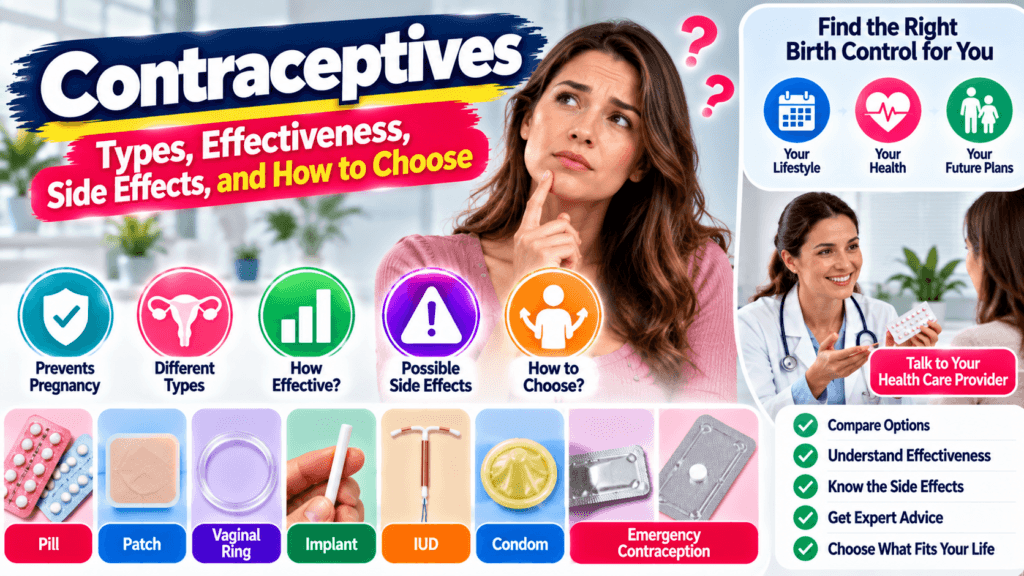
Contraceptives are medicines, devices, and practices that prevent pregnancy, and the United States now offers more choices than ever, from a small implant that works for years to a daily pill you can buy without a prescription. With so many options, the hard part is knowing which one fits your health, your lifestyle, and your plans. This guide explains how contraceptives work, compares the main types by how well they prevent pregnancy, covers emergency options and common side effects, and gives you a simple way to decide what to ask your health care provider.
What Are Contraceptives and How Do They Work?
Contraceptives work in a few basic ways. Some stop ovulation so no egg is released, some thicken cervical mucus so sperm cannot reach an egg, some change the lining of the uterus, and some create a physical barrier that keeps sperm and egg apart. Permanent methods block or remove the tubes that carry eggs or sperm. No single method is best for everyone, because the right choice depends on how effective you need it to be, whether you want to be able to stop it easily, any medical conditions you have, and whether you also need protection from sexually transmitted infections (STIs).
One idea matters more than any other when you compare methods: the difference between perfect use and typical use. Perfect use means using the method exactly right every time, while typical use reflects real life, including missed pills, late injections, and condoms that slip or break. Typical use rates are the ones to focus on, because that is what most people actually experience.
Important: Only condoms, and especially latex and polyurethane condoms, lower the risk of many STIs. Pills, implants, IUDs, and the shot prevent pregnancy but do not protect against infection.
Types of Contraceptives and How Well They Work
The table below uses figures published by the U.S. Department of Health and Human Services and the CDC. They show how many women out of 100 have an unintended pregnancy during the first year of typical use.
| Method | Unintended pregnancies per 100 women, first year of typical use |
|---|---|
| Implant | 0.05 |
| Hormonal IUD | 0.2 |
| Copper IUD | 0.8 |
| Vasectomy (male sterilization) | 0.15 |
| Female sterilization | 0.5 |
| Injectable (the shot) | 6 |
| Pill, patch, or vaginal ring | 9 |
| Diaphragm | 12 |
| Male condom | 18 |
| Female (internal) condom | 21 |
| Spermicide | 28 |
In plain terms, methods you set up once and then forget are the most reliable, methods you must remember on a schedule come next, and methods you must use correctly at each act of sex are the least reliable.
Long-Acting Reversible Contraceptives (Implants and IUDs)
Long-acting reversible contraceptives, often called LARCs, are the most effective reversible choices, and they require almost no daily effort. The contraceptive implant is a small rod placed under the skin of the upper arm that releases a hormone for about three years. An intrauterine device (IUD) is a small T-shaped device placed in the uterus by a clinician. Hormonal IUDs release a progestin and last roughly three to eight years depending on the brand, while the copper IUD contains no hormones and can work for up to about ten years. Both types can be removed at any time, and fertility generally returns soon after removal.
Also Read : 6 Week Ultrasound: What Does Your Baby Look Like at 6 Weeks?
These methods have tradeoffs. Insertion can cause cramping, and hormonal methods may change your bleeding pattern, with irregular spotting common in the first months. The copper IUD can make periods heavier and more painful for some people. Uterine perforation during IUD insertion is rare, occurring in about 1 in 1,000 insertions according to ACOG figures.
Hormonal Methods: The Pill, Patch, Ring, and Shot
Short-acting hormonal contraceptives are widely used and easy to start. Combined methods contain estrogen and a progestin and include the combined pill, the patch, and the vaginal ring, while progestin-only options include the mini-pill and the injectable. The shot is given about every three months at a clinic. Pills, patches, and rings have a typical use failure rate of about 9 percent, mostly because doses are missed or applied late, so setting phone reminders helps a lot.
In 2023 the FDA approved Opill (norgestrel), the first over-the-counter birth control pill in the United States, for all users of reproductive age, and it reached stores and online retailers in 2024. It is a progestin-only daily pill that should be taken at the same time each day. The FDA says it should not be used by people with current or past breast cancer, and it should not be combined with other hormonal birth control. Some states require insurers to cover over-the-counter birth control, but coverage is not universal, so compare prices before buying.
Tip: Estrogen-containing methods are not recommended for everyone. Tell your provider if you smoke, are over 35, get migraines with aura, have high blood pressure, or have a history of blood clots, since these can change which methods are safe for you.
Barrier Methods and STI Protection
Barrier methods include male condoms, female (internal) condoms, diaphragms, and spermicides. Their main advantage is that they work only when needed and have no hormonal side effects. Male condoms are the only widely available method that both prevents pregnancy and lowers STI risk, which is why many people pair them with another method for extra protection. Their weakness is user error, with about 18 pregnancies per 100 women in the first year of typical use. Store condoms away from heat, check the expiration date, use water-based or silicone lubricant with latex, and put one on before any genital contact. Spermicides work least well, so they are best used alongside another method rather than alone.
Permanent and Natural Methods
Surgical sterilization is intended for people who are sure they do not want future pregnancies. Female sterilization, often called tubal ligation, and male sterilization, called vasectomy, are both highly effective, and vasectomy is generally a simpler procedure. After a vasectomy, you must use another method until a semen test confirms it worked.
Fertility awareness methods involve tracking your cycle, body temperature, or cervical mucus to avoid sex or use a barrier on fertile days. They have no side effects but require consistency and work much less reliably in typical use than hormonal or long-acting methods. Withdrawal, also called the pull-out method, is among the least reliable approaches because sperm can be present before ejaculation.
Emergency Contraceptives
Emergency contraception is a backup for unprotected sex, a broken condom, or missed pills, and it is not meant to be a regular method. The copper IUD is the most effective emergency option when inserted within five days, and ACOG notes that its effectiveness is not affected by body weight. Emergency contraceptive pills come in two main types. Ulipristal acetate is approved for use up to 120 hours (five days) after unprotected sex and is more effective than levonorgestrel pills, which work best the sooner they are taken and are available over the counter. Evidence suggests levonorgestrel pills may be less effective in people with a higher body weight, so a copper IUD or ulipristal may be better choices, although ACOG advises that oral emergency contraception should not be withheld on the basis of weight. Levonorgestrel emergency contraception does not cause an abortion. Take it as soon as possible, because every hour matters.
Also Read: Placenta Previa on Ultrasound: What Does It Mean?
Common Side Effects and Risks
Side effects depend on the method, and many settle within the first three months. Hormonal contraceptives can cause spotting, nausea, breast tenderness, headaches, or mood changes, and the FDA describes these effects for Opill as generally mild. Combined estrogen methods carry a small increased risk of blood clots, which is why screening matters. Copper IUDs may cause heavier periods, and implants often cause irregular bleeding. Serious problems are uncommon, but call your provider promptly for severe leg pain or swelling, chest pain, sudden shortness of breath, severe headaches, vision changes, or very heavy bleeding. If a side effect bothers you, do not just stop quietly, because there are many alternatives and a switch is often easy.
How to Choose the Right Contraceptive
Start by asking yourself a few questions. How important is it that the method is highly effective? Do you want something you can forget about, or are you comfortable with a daily or monthly routine? Do you want children in the near future, and how quickly do you want fertility to return? Do you need STI protection? Do you have health conditions or take medicines that affect your options? Then talk with a clinician, since a short visit can match your answers to the safest choices. Many people do well combining methods, such as an IUD or pill plus condoms.
Cost and Access in the United States
Under the Affordable Care Act, most private health plans must cover FDA-approved contraceptive methods without out-of-pocket costs, though some plans, including certain religious employers, are exempt, and the specific brand may require a prior authorization. Medicaid, Title X family planning clinics, community health centers, and local health departments offer low-cost or free options. Pharmacies sell condoms, spermicide, emergency contraceptive pills, and Opill without a prescription, and some states allow pharmacists to prescribe certain hormonal methods. Check your own plan and state rules.
This article is for educational and informational purposes only and is not a substitute for professional medical advice, diagnosis, or treatment. Always consult a qualified healthcare professional for advice about your individual health.