
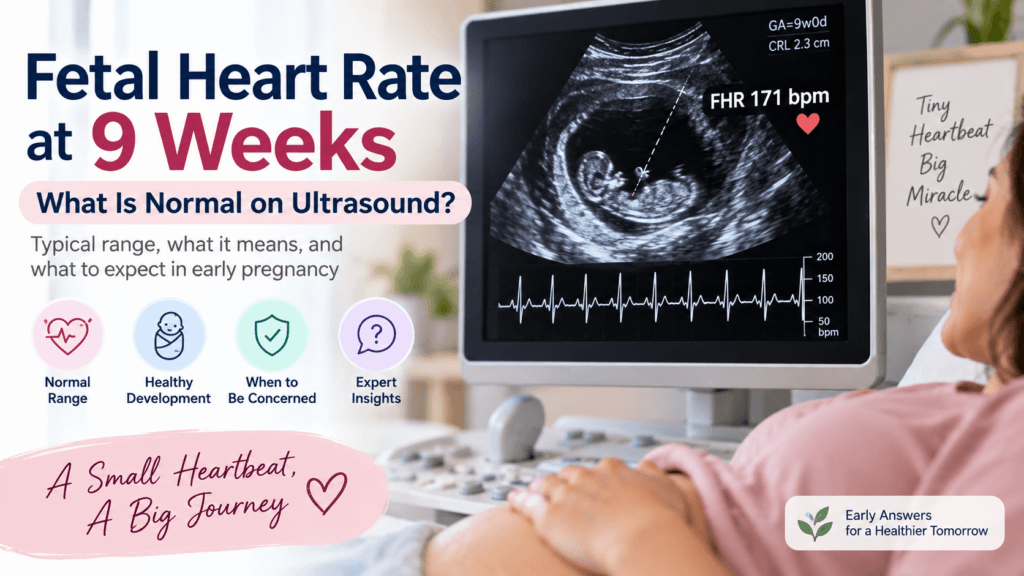
Seeing your baby’s heartbeat on an ultrasound at 9 weeks can be one of the most reassuring moments of early pregnancy. At this stage, the fetal heart is beating much faster than an adult heart, and the rate is usually near its early-pregnancy peak.
Research shows that fetal heart rate rises rapidly during the first trimester, reaching its highest levels around 9–10 weeks before gradually decreasing later in pregnancy.
Quick Answer
At 9 weeks of pregnancy, a fetal heart rate around 160–180 beats per minute (bpm) is commonly seen. Large ultrasound studies have reported a median around 171–177 bpm at 9 weeks, although individual measurements can vary.
There is no single heartbeat number that is considered “perfect.” The interpretation depends on the exact gestational age, crown-rump length (CRL), ultrasound findings, and the overall clinical picture.
What Is the Fetal Heart Rate at 9 Weeks?
At 9 weeks, the fetal heart rate is generally near its first-trimester peak.
One large study of pregnancies between 6 and 10 weeks reported the following reference values:
| Gestational age | 5th percentile | Median | 95th percentile |
|---|---|---|---|
| 8 weeks | 158 bpm | 174 bpm | 186 bpm |
| 9 weeks | 162 bpm | 176 bpm | 188 bpm |
| 10 weeks | 160 bpm | 174 bpm | 186 bpm |
These figures are reference intervals from one study population, not strict diagnostic cutoffs for every pregnancy.
Another ultrasound study found a mean fetal heart rate of approximately 172 bpm at 9 weeks, with the rate gradually decreasing after the early first-trimester peak.
So, if an ultrasound report at 9 weeks says 165, 170, 175, or 180 bpm, those numbers can all be compatible with normal early pregnancy development.
Is 170 bpm Normal at 9 Weeks?
Yes. 170 bpm is a very typical finding at 9 weeks.
Studies have consistently shown that fetal heart rate rises quickly during the early weeks of pregnancy. A study of more than 5,000 pregnancies found that the highest heart rates occurred around 9–10 weeks.
Therefore, seeing a heart rate of 170 bpm on a 9-week ultrasound generally should not be considered too fast simply because it is higher than the familiar 110–160 bpm range often quoted for later pregnancy.
That later range does not apply in the same way to a 9-week embryo/fetus.
Is a Heart Rate Above 180 bpm Normal at 9 Weeks?
It can be.
The expected heart rate varies according to exact gestational age and other factors. In one large reference study, the 95th percentile at 9 weeks was 188 bpm.
Therefore, a reading slightly above 180 bpm does not automatically mean there is a problem.
However, an unusually high heart rate should be interpreted by the clinician performing or reviewing the ultrasound, particularly if it is persistent or accompanied by other abnormal findings.
A single number should not be interpreted without considering the pregnancy as a whole.
Is a Low Heart Rate at 9 Weeks Concerning?
A slower-than-expected fetal heart rate can sometimes be associated with an increased risk of early pregnancy loss, particularly in the earlier part of the first trimester. However, there is no single heart-rate cutoff at 9 weeks that can diagnose miscarriage.
ACOG emphasizes that certain ultrasound findings, including slow fetal heart rate in early pregnancy, can be associated with pregnancy loss but should not by themselves be used as definitive evidence of pregnancy failure.
Also Read : Umbilical Cord Around Baby’s Neck on Ultrasound: What Does It Mean?
Research also shows that the significance of a heart rate depends strongly on gestational age. For example, a rate that might be concerning at one stage may be expected at another.
If the heart rate is lower than expected, your healthcare provider may consider:
- Exact gestational dating
- Crown-rump length
- Repeat ultrasound
- Gestational sac and yolk sac findings
- Symptoms such as vaginal bleeding or pelvic pain
- Overall pregnancy development
Why Is the Heart Rate So Fast at 9 Weeks?
The fetal heart is undergoing rapid development during the first trimester.
Early in pregnancy, the heart rate increases substantially as the cardiovascular system develops and matures. Research has shown an increase from approximately 110 bpm around 5 weeks to about 170 bpm around 9 weeks, followed by a gradual decline later in the first trimester.
This means a fast heartbeat at 9 weeks is generally expected rather than automatically being a sign of fetal distress.
By the end of the first trimester and into the second trimester, the fetal heart rate gradually settles into a lower range.
How Is Fetal Heart Rate Measured?
During an early pregnancy ultrasound, fetal cardiac activity can be evaluated using ultrasound imaging.
Depending on the gestational age, the type of ultrasound, and the clinical situation, the heart rate may be measured using M-mode or other ultrasound techniques.
At approximately 9 weeks, the heartbeat is usually readily visible on ultrasound when the pregnancy is developing normally.
The ultrasound examination may also measure the crown-rump length (CRL), which is an important measurement for dating an early pregnancy.
Because gestational age can sometimes differ from the date calculated from the last menstrual period, clinicians interpret the heart rate alongside the ultrasound measurements rather than looking at the bpm alone.
Does Fetal Heart Rate Predict the Baby’s Sex?
No.
You may see claims online that a faster heartbeat means a girl and a slower heartbeat means a boy. However, fetal heart rate is not a reliable method for determining fetal sex.
Research has not established fetal heart rate as a dependable sex-prediction test. A single heart-rate measurement should not be used to determine whether the baby is male or female.
Does Heart Rate Predict Miscarriage?
Fetal heart rate can provide useful information about early pregnancy development, but one heart-rate measurement cannot predict the outcome of a pregnancy with certainty.
Studies have found that unusually slow heart rates in early pregnancy can be associated with an increased risk of pregnancy loss. However, the importance of the finding varies with gestational age, and other ultrasound measurements are also important.
Also Read : Placenta Is Low-Lying at 20 Weeks: What Happens Next?
At 9 weeks, clinicians may look at several findings together, including:
- Fetal heart rate
- CRL
- Growth compared with expected gestational age
- Gestational sac
- Yolk sac
- Fetal development
- Maternal symptoms
A reassuring heartbeat is an encouraging finding, but it is only one part of an ultrasound examination.
What Else Is Checked at a 9-Week Ultrasound?
A 9-week ultrasound may evaluate several aspects of early pregnancy.
Crown-Rump Length
The CRL measures the embryo/fetus from the top of the head to the bottom of the torso. It is commonly used to help establish gestational age during early pregnancy.
Fetal Heart Activity
The sonographer or clinician checks for cardiac activity and may measure the fetal heart rate.
Pregnancy Location
The ultrasound confirms that the pregnancy is located inside the uterus and evaluates the developing pregnancy structures.
Yolk Sac and Gestational Sac
These structures can also be assessed as part of the overall evaluation of early pregnancy.
Other Findings
Depending on the reason for the examination, the ultrasound may evaluate the uterus, ovaries, cervix, placenta as it develops, and any bleeding or other abnormalities.
The exact components of an ultrasound vary according to the clinical situation.
When to Seek Medical Care
A fetal heart rate around 170 bpm at 9 weeks is generally reassuring, but you should contact your healthcare provider if you experience concerning pregnancy symptoms.
Seek medical evaluation for symptoms such as:
- Heavy vaginal bleeding
- Severe or persistent abdominal or pelvic pain
- Dizziness or fainting
- Shoulder pain associated with concerning abdominal symptoms
- Fever or feeling seriously unwell
- Any significant change that your pregnancy care team has instructed you to report
If you have already had an ultrasound showing a heartbeat but develop significant bleeding or pain afterward, do not assume that the previous reassuring ultrasound means everything is still okay. Contact your healthcare provider.
What is a normal fetal heart rate at 9 weeks?
There is no single universal normal number. Research commonly places the fetal heart rate around 160–180 bpm at 9 weeks, with a median around 170–177 bpm in several studies.
Is 160 bpm normal at 9 weeks?
Yes. A heart rate of 160 bpm can be normal at 9 weeks. The exact interpretation depends on gestational age, CRL, and the rest of the ultrasound findings.
Is 170 bpm normal at 9 weeks?
Yes. 170 bpm is a very typical fetal heart rate at 9 weeks, when the fetal heart rate is near its early-pregnancy peak.
Is 180 bpm normal at 9 weeks?
It can be. Some healthy pregnancies have heart rates around 180 bpm at 9 weeks. In one large study, the 95th percentile at 9 weeks was 188 bpm.
Can fetal heart rate tell if it is a boy or girl?
No. Fetal heart rate is not a reliable method for determining fetal sex.
Does fetal heart rate decrease after 9 weeks?
Generally, yes. Fetal heart rate rises rapidly during early pregnancy and tends to peak around 9–10 weeks before gradually decreasing later in the first trimester.

