
A circumvallate placenta is a structural variation of the placenta in which the chorionic plate, the fetal-facing portion of the placenta, is smaller than the underlying basal plate. Because the membranes fold back toward the fetal surface around the placental edge, the placenta can develop a raised, thickened or rolled-looking margin. This condition is considered a type of extrachorial placenta.
Circumvallate placenta is often discussed after an ultrasound shows a placental shelf, ridge or unusual folded edge. However, diagnosing it accurately during pregnancy can be difficult. Some ultrasound findings that resemble a circumvallate placenta may not represent a true circumvallate placenta confirmed after delivery. Older research found that prenatal ultrasound had limited accuracy, while newer research suggests that a prenatal ultrasound finding of circumvallate placenta may not necessarily be associated with poor pregnancy outcomes.
What Is a Circumvallate Placenta?
A circumvallate placenta is an abnormal placental morphology in which the chorionic plate does not extend all the way to the outer edge of the placenta. The basal plate is larger, leaving part of the peripheral placenta uncovered on the fetal side. The chorion and amnion fold back over this area, creating a raised or thickened rim.
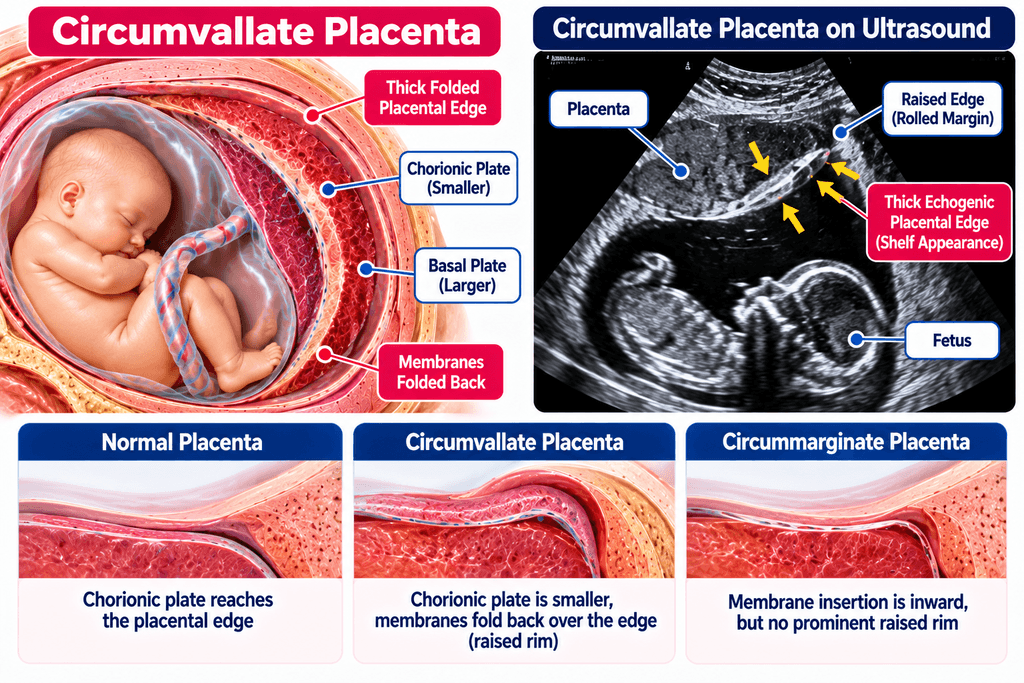
The appearance can be thought of as a raised border around part of or much of the placental edge. Depending on how extensive the abnormality is, it may be described as partial or complete.
The condition belongs to a group called extrachorial placentas. Circumvallate and circummarginate placentas are the two major forms of placenta extrachorialis.
How Does Circumvallate Placenta Develop?
The exact reason a circumvallate placenta develops is not completely understood.
During normal placental development, the chorionic plate and basal plate have a particular relationship. With circumvallate placenta, the chorionic plate is smaller than the basal plate, allowing the peripheral placental tissue to extend beyond the chorionic plate. The fetal membranes then fold back over the placental margin.
The resulting folded edge is responsible for the characteristic shelf or ridge that may be visible during ultrasound examination. This is a structural placental variation and is not something a pregnant person causes through normal daily activities.
What Does Circumvallate Placenta Look Like on Ultrasound?
The ultrasound appearance can vary depending on gestational age, placental location and the extent of the placental abnormality.One of the classic findings is a thick, linear band of echoes extending from one placental edge toward the other. In cross-section, the appearance may resemble two shelves rising above opposite sides of the placenta.
Another described appearance is a raised echogenic ridge along the placental margin. A shelf-like structure may also be seen projecting inward from the placental edge.
Also Read : Can Ultrasound Detect Placenta Accreta?
Three-dimensional ultrasound can sometimes demonstrate the placental surface more clearly. A circumferential depression surrounded by a thick peripheral ring, sometimes called a “tire sign,” has been described as a possible imaging marker.
However, these findings should not automatically be interpreted as definite circumvallate placenta because several other intrauterine structures can produce a similar appearance.
Ultrasound Signs of Circumvallate Placenta
Raised Placental Edge
A raised or rolled placental margin is one of the characteristic ultrasound appearances. The edge may look thicker than the central placental tissue.
Placental Shelf
A shelf-like echogenic structure may be seen at the placental margin. This represents folded membranes and peripheral placental tissue.
Thick Echogenic Ridge
A linear echogenic band may extend from one placental edge toward another. This can be particularly noticeable during the second-trimester anatomy scan.
Peripheral Placental Ring
Three-dimensional imaging may demonstrate a thick peripheral ring surrounding a depressed central fetal placental surface.
Increased Placental Thickness
Increased placental thickness has also been investigated as a possible marker of circumvallate placenta. However, placental thickness alone cannot establish the diagnosis because placental thickness naturally varies with gestational age and other conditions.
Can Ultrasound Accurately Diagnose Circumvallate Placenta?
Not always.
This is one of the most important points for patients who see “circumvallate placenta” on an ultrasound report.
A classic study evaluating prenatal sonography found that circumvallate placenta was difficult to diagnose accurately with ultrasound. Experienced sonologists missed many pathology-confirmed cases, while some normal placentas were incorrectly interpreted as circumvallate.
Also Read : What Is a Fetal Echocardiogram? When Is It Recommended?
This means that an ultrasound appearance suggestive of circumvallate placenta is not necessarily the same as a pathology-confirmed circumvallate placenta.
In many cases, the definitive morphology can be better appreciated after delivery when the placenta can be examined directly.
A prenatal ultrasound finding should therefore be interpreted in the context of the entire pregnancy rather than treated as a diagnosis that automatically predicts complications.
Circumvallate Placenta vs Circummarginate Placenta
Circumvallate and circummarginate placenta are related conditions, but their morphology is different.
In a circumvallate placenta, the membranes fold back over the placental edge and create a raised or thickened peripheral rim. The fetal surface may have a central depression surrounded by this rim.
In a circummarginate placenta, the membrane insertion is also located inside the placental margin, but the fetal surface is generally flatter and lacks the prominent raised peripheral ring characteristic of circumvallate placenta.
Because these findings can be subtle on ultrasound, distinguishing them accurately may sometimes be difficult.
What Are the Pregnancy Risks?
Historically, circumvallate placenta has been associated with several pregnancy complications.
Older studies and pathology-based research have reported associations with vaginal bleeding, preterm delivery, placental abruption, premature rupture of membranes, fetal growth restriction or small-for-gestational-age infants, and emergency cesarean delivery.
A 2023 systematic review and meta-analysis also found associations between circumvallate placenta and increased rates of preterm birth, placental abruption and emergency cesarean delivery. However, the authors noted limitations in the available evidence. Importantly, these associations do not mean that every pregnancy with a circumvallate placenta will experience these complications.
Does a Prenatal Ultrasound Diagnosis Mean the Pregnancy Is High Risk?
Not necessarily.
A more recent U.S. study specifically examined pregnancies with a prenatal ultrasound diagnosis of circumvallate placenta. Among the pregnancies studied, outcomes were similar between the circumvallate group and matched controls. The researchers concluded that a prenatal ultrasound diagnosis alone did not appear to be associated with adverse pregnancy outcomes and suggested that additional surveillance may not be necessary when the pregnancy is otherwise uncomplicated.
This is important because older studies often evaluated placentas after delivery and confirmed the condition by pathology. Prenatal ultrasound diagnosis may identify a broader group of placental appearances that do not represent the same pathology.
Therefore, the significance of a circumvallate placenta finding should be individualized.
Does Circumvallate Placenta Affect Baby’s Growth?
Some historical studies have reported an association between circumvallate placenta and fetal growth restriction or low birth weight.
However, a prenatal ultrasound diagnosis does not automatically mean that the baby will have growth problems.
Your healthcare provider may consider fetal growth measurements, amniotic fluid, placental appearance and other pregnancy factors when deciding whether additional ultrasound monitoring is appropriate.
If fetal growth is normal and there are no other concerning findings, a circumvallate appearance by itself may not require a change in pregnancy management.
Does Circumvallate Placenta Cause Bleeding?
Circumvallate placenta has been associated with vaginal bleeding in some studies.
The abnormal placental edge and folded membranes may be associated with bleeding or placental complications. However, not everyone with a circumvallate placenta will experience vaginal bleeding.
Any vaginal bleeding during pregnancy should be discussed with a healthcare professional because bleeding can have many different causes, including placenta previa, placental abruption, cervical changes, infection and other pregnancy-related conditions.
Does Circumvallate Placenta Increase the Risk of Placental Abruption?
Some pathology-based studies have reported an association between circumvallate placenta and placental abruption.
However, the presence of a circumvallate appearance on a prenatal ultrasound should not be interpreted as proof that placental abruption will occur.
If symptoms such as vaginal bleeding, sudden abdominal pain, uterine tenderness or contractions develop, urgent medical evaluation is appropriate regardless of whether a circumvallate placenta has previously been reported.
Does Circumvallate Placenta Require Extra Monitoring?
There is no universal requirement that every pregnancy with a prenatal ultrasound diagnosis of circumvallate placenta receive additional surveillance.
The recent U.S. study of prenatally diagnosed cases found no significant difference in adverse pregnancy outcomes and concluded that additional surveillance may not be necessary when the pregnancy is otherwise uncomplicated.
However, management may be different when other findings are present. For example, a provider may recommend additional growth scans when there is fetal growth concern, abnormal amniotic fluid, vaginal bleeding, suspected placental complications or another maternal or fetal risk factor.
Your obstetrician or maternal-fetal medicine specialist can determine whether additional monitoring is appropriate for your individual pregnancy.
When Should You Contact Your Doctor?
Contact your healthcare provider promptly if you develop vaginal bleeding during pregnancy, especially if it is heavy or associated with pain.
Urgent evaluation is especially important if you experience sudden severe abdominal pain, persistent contractions, significant vaginal bleeding, leaking fluid, dizziness or fainting, or decreased fetal movement.
These symptoms are not specific to circumvallate placenta, but they can occur with serious pregnancy complications that require prompt assessment.
Is circumvallate placenta dangerous?
Not necessarily. A circumvallate placenta has historically been associated with several pregnancy complications, but a recent study of prenatal ultrasound diagnoses found similar outcomes compared with matched pregnancies without the diagnosis.
Can circumvallate placenta be seen on ultrasound?
Yes. A raised placental edge, shelf-like structure, thick echogenic ridge or folded membrane may suggest circumvallate placenta. However, prenatal ultrasound diagnosis is not always accurate.
Can circumvallate placenta cause fetal growth restriction?
It has been associated with fetal growth restriction and small-for-gestational-age infants in some historical studies, but a prenatal ultrasound diagnosis alone does not mean that fetal growth will be abnormal.
Can circumvallate placenta resolve?
The ultrasound appearance can change as pregnancy progresses. A placental shelf or membrane fold seen earlier in pregnancy may become less obvious later. Because prenatal diagnosis can be difficult, follow-up interpretation should be based on the complete clinical and ultrasound picture.
Is circumvallate placenta the same as placenta previa?
No. Placenta previa is a placental location problem in which the placenta covers or approaches the internal cervical opening. Circumvallate placenta is a structural abnormality of the placental edge.
Medical Disclaimer
Medical Disclaimer: This article is for educational and informational purposes only and is not a substitute for professional medical advice, diagnosis, or treatment. Always consult a qualified healthcare professional for advice about your individual health or pregnancy.
Sources
PubMed — Prenatal Ultrasound Findings of Circumvallate Placenta and Pregnancy Outcomes.
PubMed — Accuracy of Prenatal Sonography for Detecting Circumvallate Placenta.
PubMed — Circumvallate Placenta: Sonographic Diagnosis.
PubMed Central — Circumvallate Placenta: Associated Clinical Manifestations and Complications.
PubMed — Relationship Between Abnormal Placenta and Obstetric Outcomes: A Meta-Analysis.