When is ovulation? For most people, ovulation happens about 14 days before the next period starts, not necessarily on day 14 of the cycle, and that single detail explains why so many calendar predictions miss. Knowing your ovulation day and the days around it matters whether you are trying to get pregnant, trying to understand your cycle, or just curious about your body. This guide explains when ovulation happens, how to estimate it for your cycle length, the signs to watch for, and the tracking tools that work best, along with the situations where you should talk with a health care professional.
What Is Ovulation?
Ovulation is the moment when a mature egg is released from an ovary and begins traveling down the fallopian tube, where it can be fertilized by sperm. It is triggered by a surge of luteinizing hormone (LH), which signals one follicle to release its egg. Once released, the egg survives for only about 12 to 24 hours, so there is a short window to become pregnant after ovulation. If the egg is not fertilized, it breaks down, hormone levels fall, and the uterine lining is shed as a period about two weeks later.
Important: Ovulation is the key event of the menstrual cycle for pregnancy, but the days before it matter just as much, because sperm can survive in the body for up to five days.
When Is Ovulation in a Typical Cycle?
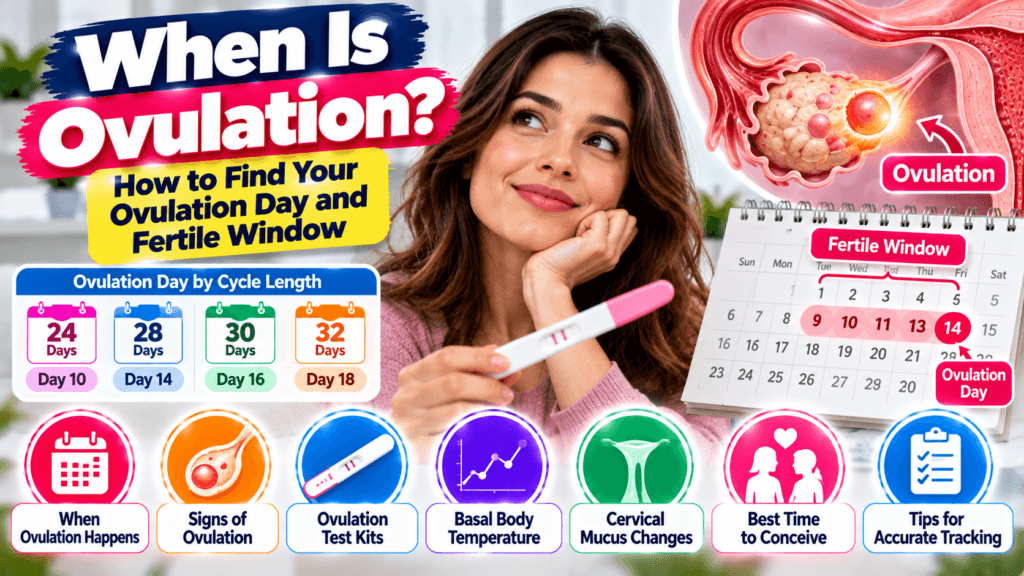
A menstrual cycle is counted from the first day of one period to the first day of the next, and the American College of Obstetricians and Gynecologists (ACOG) describes a normal adult cycle as roughly 21 to 35 days. In a 28-day cycle, ovulation usually happens around day 14. The more reliable rule is that ovulation occurs about 14 days before your next period, and this is because the luteal phase, the time from ovulation to your next period, is fairly consistent at around 12 to 16 days, averaging 14. The first half of the cycle, before ovulation, is the part that varies. That is why someone with a 35-day cycle ovulates closer to day 21, while someone with a 24-day cycle ovulates closer to day 10.
Also Read : In Vitro Fertilization (IVF): How It Works, Success Rates, Cost, and Risks
Real bodies do not follow the textbook perfectly. A large prospective study published in the BMJ found that only a small percentage of women ovulate exactly 14 days before their next period, and that the timing of the fertile window varies from cycle to cycle, even in women who consider themselves regular. Treat any calendar estimate as a starting point, not a guarantee.
Ovulation Day and Fertile Window by Cycle Length
The table below applies the 14-day rule. The fertile window is the five days before ovulation plus the day of ovulation itself, six days in total.
| Cycle length | Estimated ovulation day | Estimated fertile window (cycle days) |
|---|---|---|
| 21 days | Day 7 | Days 2 to 7 |
| 24 days | Day 10 | Days 5 to 10 |
| 26 days | Day 12 | Days 7 to 12 |
| 28 days | Day 14 | Days 9 to 14 |
| 30 days | Day 16 | Days 11 to 16 |
| 32 days | Day 18 | Days 13 to 18 |
| 35 days | Day 21 | Days 16 to 21 |
Day 1 is the first day of your period. If your cycle length changes from month to month, the estimate can be off by a week or more, so tracking signs and using ovulation tests becomes more important.
Understanding the Fertile Window
Your fertile window is the stretch of days when sex can lead to pregnancy. It lasts about six days because sperm can live in the reproductive tract for up to five days, while the egg survives only 12 to 24 hours after release. This is why pregnancy is possible from sex in the days before ovulation, and very unlikely once the egg has had a full day to expire. The most fertile days are typically the two to three days leading up to and including ovulation, with the highest chance of conception occurring when intercourse takes place one to two days before the egg is released.
Tip: If you are trying to conceive, you do not need to find the exact hour. Having sex every day or every other day throughout the fertile window covers the uncertainty.
How to Calculate Your Ovulation Date
Start by tracking the first day of your period for at least three cycles and work out your average cycle length. Then count 14 days back from the date you expect your next period. For example, if your cycles last 30 days and your last period started on the 1st, you would expect your next period on the 31st, which puts ovulation around the 17th and your fertile window from about the 12th to the 17th. Many apps and online ovulation calculators perform the same arithmetic. The method works best when your cycles are regular, and it is much less reliable when they vary.
Signs of Ovulation
Your body often gives clues, although not everyone notices all of them.
- Cervical mucus changes: As estrogen rises, cervical mucus becomes more abundant, clear, slippery, and stretchy, often compared to raw egg whites. This is one of the most reliable signs that ovulation is approaching.
- A slight rise in basal body temperature: After ovulation, progesterone raises your resting temperature by a small amount, and the increase stays until your next period.
- Mild one-sided pelvic pain: Some people feel a brief twinge or ache on one side of the lower abdomen, known as mittelschmerz.
- Other changes: Breast tenderness, mild spotting, and a higher sex drive are also common around ovulation.
Ways to Track Ovulation
No single method is perfect, so many people combine two or three. Some predict ovulation, while others only confirm it afterward.
| Method | What it tells you | Predicts or confirms? |
|---|---|---|
| Calendar method | Rough estimate from past cycle lengths | Predicts, least precise |
| Cervical mucus | Fertile-quality mucus signals the window is open | Predicts |
| Ovulation predictor kits (OPKs) | Detect the LH surge in urine | Predicts |
| Basal body temperature (BBT) | A sustained rise of at least 0.5 degrees Fahrenheit after ovulation | Confirms after the fact |
| Ultrasound or blood tests | Follicle size and hormone levels checked by a clinician | Predicts and confirms |
The American Society for Reproductive Medicine (ASRM) explains that ovulation occurs about 36 hours after the LH surge begins, and that after a positive urine LH test, ovulation usually follows within 12 to 36 hours. That makes OPKs very useful for timing sex. BBT charts, by contrast, cannot predict ovulation in the current cycle. They show that it already happened, which helps you see patterns over several months.
Also Red : Contraceptives: Types, Effectiveness, Side Effects, and How to Choose
The Best Time to Have Sex to Get Pregnant
Aim for the two to three days before ovulation and the day of ovulation itself. If you use OPKs, start testing a few days before you expect to ovulate, and plan sex on the day you get a positive result and the following day. Because sperm survive for days, you do not need to wait for the test to turn positive, and fertile cervical mucus is a signal that the window is already open. Try not to let timing take over your relationship, since regular sex throughout the cycle works well for many couples.
When Ovulation Is Hard to Predict
Several situations make ovulation timing less predictable. Irregular cycles, polycystic ovary syndrome (PCOS), thyroid conditions, significant stress, heavy exercise, and big changes in weight can all delay or stop ovulation. In PCOS, LH levels can stay high, which can cause misleading OPK results. After childbirth, ovulation can return before the first period, particularly if you are not breastfeeding, and during perimenopause cycles become less predictable. Cycles can also be anovulatory, meaning no egg is released, which is common occasionally and usually not a concern unless it happens repeatedly.
Important: Do not rely on calendar-based ovulation estimates to avoid pregnancy. Because the timing varies from cycle to cycle, use an effective birth control method if you do not want to conceive.
When to See a Doctor
Talk with your health care provider if your periods are very irregular, usually shorter than 21 days or longer than 35, if you go several months without a period, or if you have severe pelvic pain. If you are trying to conceive, ACOG generally advises seeking evaluation after 12 months of trying if you are under 35, and after 6 months if you are 35 or older. Seek help sooner if you have known conditions such as PCOS, endometriosis, or previous pelvic infections. A provider can check ovulation with blood tests or ultrasound and discuss treatment options.
This article is for educational and informational purposes only and is not a substitute for professional medical advice, diagnosis, or treatment. Always consult a qualified healthcare professional for advice about your individual health.