
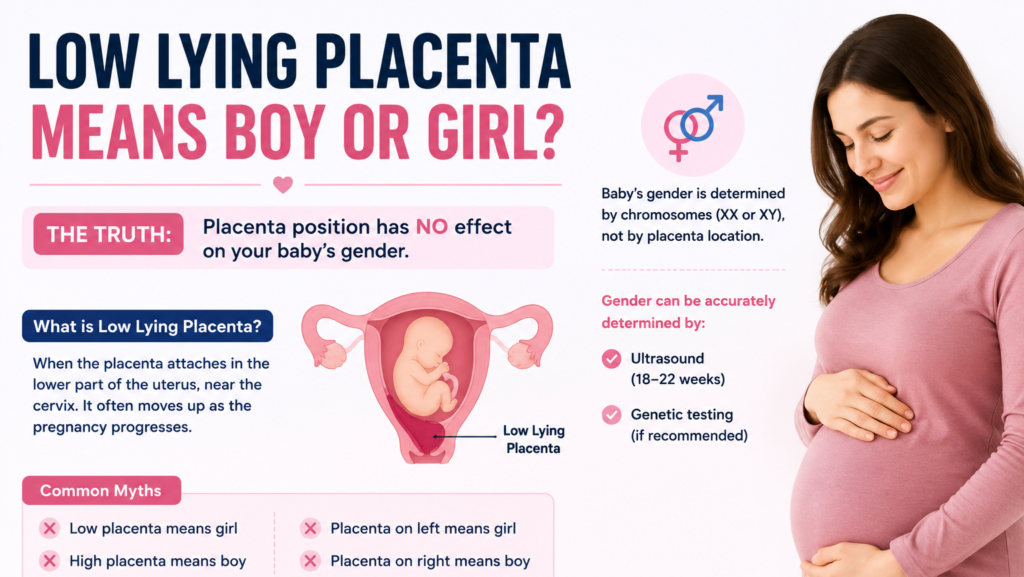
Many pregnant women become curious about their baby’s gender after reading ultrasound reports. One common question people search online is, “Does a low-lying placenta mean boy or girl?” This belief has become popular on social media, pregnancy forums, and family discussions. Some people claim that placenta position can predict whether you are carrying a baby boy or baby girl. However, medical science tells a very different story.
A low-lying placenta is a pregnancy condition related to the location of the placenta inside the uterus. It does not medically confirm the baby’s gender. Understanding what a low-lying placenta actually means can help reduce unnecessary fear and confusion during pregnancy.
What Is a Low-Lying Placenta?
The placenta is an organ that develops during pregnancy to provide oxygen and nutrients to the growing baby. Normally, the placenta attaches to the upper part of the uterus. In some pregnancies, however, the placenta implants lower in the uterus near the cervix. This condition is called a low-lying placenta.
Doctors usually identify a low-lying placenta during a routine ultrasound scan, especially during the second trimester. In many cases, the placenta moves upward naturally as the uterus expands during pregnancy.
Can Placenta Position Predict Baby Gender?
There is no scientific evidence proving that a low-lying placenta means a baby boy or baby girl. The placenta’s location depends on where the fertilized egg implants inside the uterus, not on the baby’s gender.
Some people believe in theories such as the Ramzi Theory, which suggests that placenta position on the right side may indicate a boy and the left side may indicate a girl. However, this theory is not medically accepted and is not considered reliable by healthcare professionals.
Why People Believe Low-Lying Placenta Predicts Gender
Pregnancy myths have existed for generations. Families often use old traditions and beliefs to guess a baby’s gender before birth. Since ultrasounds show the placenta clearly, many people started linking placenta location with gender prediction.
Common myths include:
- Low placenta means baby girl
- High placenta means baby boy
- Placenta on the left side means girl
- Placenta on the right side means boy
While these ideas may sound fun, they are not accurate medical methods for determining gender.
How Baby Gender Is Actually Determined
A baby’s gender is determined at conception by chromosomes from the sperm and egg. If the sperm carries an X chromosome, the baby will usually be female. If it carries a Y chromosome, the baby will usually be male.
The placenta’s position inside the uterus has no connection to these chromosomes. Placenta location changes depending on implantation and uterine growth, not fetal sex.
When Can Ultrasound Reveal Baby Gender?
Most doctors can identify baby gender through ultrasound between 18 and 22 weeks of pregnancy during the anatomy scan. During this stage, the baby’s reproductive organs are developed enough to become visible on ultrasound.
Before this stage, accurate gender determination is difficult. Early pregnancy signs, cravings, placenta location, or belly shape cannot reliably predict whether the baby is a boy or girl.
Symptoms of a Low-Lying Placenta
Many women with a low-lying placenta experience no symptoms at all. The condition is often discovered accidentally during a routine pregnancy scan. However, some women may experience:
- Light vaginal bleeding
- Spotting during pregnancy
- Mild pelvic discomfort
- Bleeding after intercourse
Any bleeding during pregnancy should always be discussed with a healthcare provider.
Is Low-Lying Placenta Dangerous?
In most early pregnancies, a low-lying placenta is not dangerous. As the uterus grows, the placenta often moves upward naturally. This process is called placental migration.
Doctors usually monitor placenta position with follow-up ultrasounds later in pregnancy. If the placenta remains too close to or covers the cervix near delivery, it may become placenta previa, which can require special monitoring or cesarean delivery.
Can Low-Lying Placenta Harm the Baby?
Most women with a low-lying placenta go on to have healthy pregnancies and healthy babies. The condition itself does not affect whether the baby is male or female.
Also Read : 7 Ultrasound Results That Need Immediate Attention
However, if heavy bleeding occurs or the placenta remains very low late in pregnancy, doctors may recommend additional precautions to protect both mother and baby.
Common Pregnancy Gender Myths
Many myths claim to predict baby gender during pregnancy. Some popular examples include:
- Carrying low means boy
- Carrying high means girl
- Sweet cravings mean girl
- Salty cravings mean boy
- Morning sickness means girl
- Fast heartbeat means girl
Although these beliefs are widely shared, none of them are scientifically proven methods for gender prediction.
Medical Facts About Placenta Position
Placenta position is medically important because it helps doctors monitor pregnancy health and delivery planning. Ultrasound reports may describe the placenta as:
- Anterior placenta
- Posterior placenta
- Fundal placenta
- Low-lying placenta
These terms describe where the placenta is attached inside the uterus. They are not indicators of baby gender.
Emotional Impact of Pregnancy Myths
Many parents become emotionally attached to gender predictions early in pregnancy. While guessing games can be fun, relying too heavily on myths may create disappointment or confusion later.
It is important to remember that the most important goal during pregnancy is the health of both mother and baby, regardless of gender.
How Doctors Monitor Low-Lying Placenta
If a low-lying placenta is detected, doctors usually schedule follow-up ultrasounds later in pregnancy to check whether the placenta has moved upward. Most cases diagnosed early improve naturally before delivery.
Also Read : Low Lying Placenta: Does It Mean Boy or Girl?
Healthcare providers may also advise avoiding heavy lifting, excessive physical strain, or sexual activity in some situations if bleeding occurs.
Healthy Pregnancy Tips With Low-Lying Placenta
Women diagnosed with a low-lying placenta should continue regular prenatal care and follow medical advice carefully. Helpful pregnancy tips include:
- Attend all ultrasound appointments
- Avoid smoking and alcohol
- Stay hydrated
- Get enough rest
- Report any bleeding immediately
- Take prenatal vitamins regularly
Maintaining a healthy lifestyle supports overall pregnancy health for both mother and baby.
Final Thoughts on Low-Lying Placenta and Baby Gender
A low-lying placenta does not mean boy or girl. Placenta position is not a medically reliable way to predict baby gender. Although pregnancy myths and theories remain popular online, scientific evidence does not support a connection between low-lying placenta and fetal sex.
The best way to determine baby gender accurately is through medical ultrasound during the second trimester or genetic testing if recommended. Instead of focusing on myths, expectant parents should prioritize regular prenatal care and healthy pregnancy habits for the safest possible pregnancy journey.

